
How Do I Rank My Website in AI Search Engines Like ChatGPT, Perplexity, and Google AI Overview?
TL;DR:
- What it is: AI search engines don't rank a list of pages. Instead, they read the web, synthesize an answer, and cite a small handful of sources they trust enough to quote.
- What it takes: Answer-first content, schema markup, open access for AI crawlers (GPTBot, PerplexityBot, Google-Extended), and consistent brand mentions across the wider web.
- What it costs: Mostly time, not budget: the highest-leverage fixes (crawler access, schema, restructuring existing pages) are free to implement, though agencies typically run audits and ongoing programs from a few hundred dollars a month.
- Who it's for: Any business that depends on search traffic and has noticed clicks softening even while keyword rankings hold, including SaaS companies, service businesses, ecommerce brands, and local businesses alike.
If organic traffic has been sliding even though your keyword rankings look fine, this is usually why: a growing share of searches now end inside an AI answer instead of a search results page. The user asks ChatGPT, Perplexity, or Google's AI Overview a question, gets a synthesized response, and never clicks through. Your page might be one of the sources behind that answer, or it might not exist to the model at all. Getting cited is a different discipline than ranking #1, and most sites are still only playing the old game.
This guide breaks down how AI search actually selects sources, and the specific changes worth making in 2026. If you'd rather have someone audit and fix this for you, our AI SEO services team runs this exact process for clients across ChatGPT, Perplexity, and Google AI Overview visibility.
Need Help Ranking in AI? Explore Services →
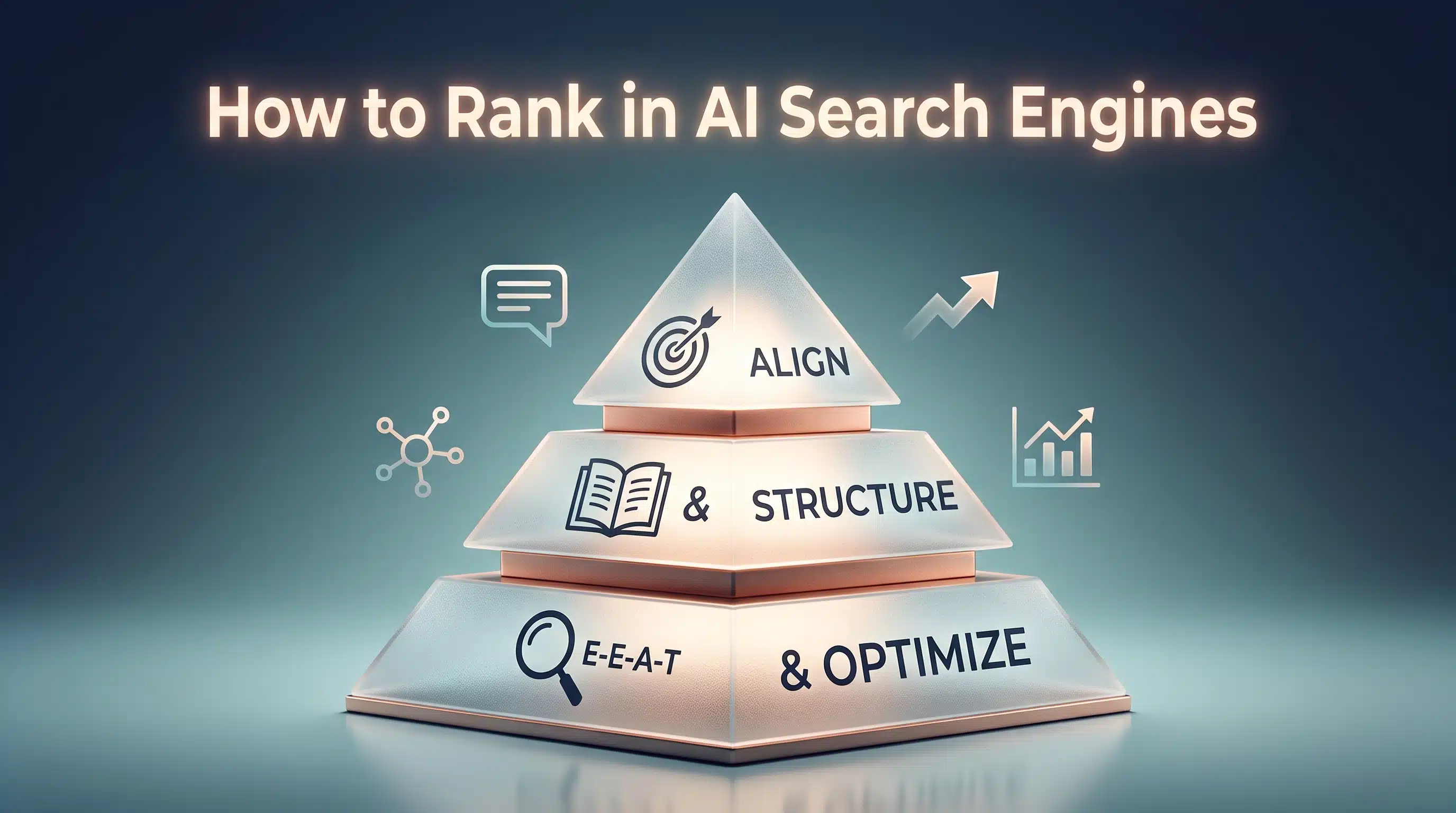
What Is AI Search and How Is It Different From Google Rankings?
AI search engines like ChatGPT, Perplexity, and Google's AI Overview don't return ten blue links for a user to sort through. They retrieve content from multiple sources in real time, synthesize it into a single answer, and, depending on the engine, cite the sources they drew from. There's no position #1 to fight over. There's a pool of passages the model was confident enough to pull from and quote.
Here's what that means in practice:
- There's no fixed number of "results": a model might cite one source or eight, depending entirely on how well each one answers the question
- The unit being evaluated is a passage, not a page: a single well-structured paragraph can get cited even from an otherwise mediocre page
- Being technically accessible is a prerequisite, not a ranking factor: if AI crawlers are blocked, none of your content quality matters
- Corroboration counts: models weigh whether other credible sources say something similar, not just what your own site claims
- The result updates constantly: AI engines re-crawl and re-synthesize far more frequently than a traditional ranking updates
In short, "ranking" is being replaced by "getting cited." That shift changes what optimized content actually looks like.
How Ranking in AI Search Helps Your Business
Whether you run a local service business, a SaaS company, or an ecommerce brand, showing up inside an AI answer puts your business in front of a buyer at the exact moment they're deciding, often before they've even opened a traditional search results page.
For local and service businesses: get named as the answer
When someone asks an AI assistant for a recommendation in your area, being the cited source is effectively a direct referral. This works alongside, not instead of, a strong local SEO foundation, since AI engines still lean on the same signals that drive local map rankings.
For SaaS and B2B companies: win the comparison question
Buyers increasingly ask AI tools to compare software options before ever visiting a vendor site. Being cited in that comparison, accurately and favorably, shapes the shortlist before a traditional content marketing funnel even gets the chance to.
For ecommerce brands: influence "best of" and product-question answers
Product comparisons, "what's the best X for Y" questions, and spec lookups are exactly the queries AI search engines handle well. Structured product data and clear, current specs make it far more likely your listings get pulled into the answer instead of a competitor's.
For agencies and marketers: a new visibility channel to report on
AI search citations are measurable, trackable, and increasingly something clients ask about directly. Adding AI visibility tracking alongside existing SEO reporting gives marketers a way to show up in a channel most competitors haven't started optimizing for yet.
How AI Search Engines Actually Choose What to Cite
Every major AI engine converges on the same underlying signals, even though the exact mechanics differ:
- Retrievability: the page has to be crawlable and indexed; blocked crawlers make everything else irrelevant
- Extractability: the answer needs to sit in a self-contained passage the model can lift cleanly, without stitching together fragments
- Corroboration: if several credible sources agree with your claim, you're more likely to be treated as reliable; being the lone outlier hurts you
- Authority signals: named authors with real credentials, consistent brand mentions across the web, and citations from other reputable sites
- Freshness: especially for pricing, tools, statistics, and "best of" content, where stale claims get quietly dropped from consideration
Write every page as if a smart colleague has eight seconds to skim it and then has to repeat your answer to someone else, in their own words. If they couldn't do that from your page, an AI model can't either.
9 Ways to Get Cited by AI Search Engines
- Answer the question in the first 2–3 sentences: don't bury the answer under paragraphs of preamble. Open with it, then support it
- Structure content for extraction: use H2s and H3s phrased the way people actually ask questions, and break out lists, steps, and short tables wherever possible
- Add structured data markup:
FAQPage,HowTo, andArticleschema give crawlers an explicit, machine-readable version of your content - Open access to AI crawlers: confirm GPTBot, PerplexityBot, Google-Extended, and ClaudeBot aren't blocked in robots.txt or a security plugin
- Build corroboration beyond your own site: reviews, forum mentions, comparison roundups, and press coverage all raise the odds your version of the story gets picked up
- Strengthen real E-E-A-T signals: named authors with credentials, linked sources, and original data or first-hand experience
- Keep time-sensitive content current: visible last-updated dates on pricing, tools, and "best of" pages, and content that actually reflects them
- Publish something nobody else has: original research or a genuinely different angle gives a model a reason to cite you specifically
- Track your AI visibility directly: periodically run target questions through each engine and note whether, and how, you're cited

How to Optimize Your Site for AI Search: A Step-by-Step Guide
Getting started doesn't require a full rebuild; most of the highest-impact work happens on pages you already have.
- Audit crawler access: check robots.txt and any security/CDN settings for rules blocking GPTBot, PerplexityBot, Google-Extended, or ClaudeBot
- Identify your highest-intent pages: the pages already answering real customer questions: pricing, comparisons, how-tos, FAQs
- Rewrite for answer-first structure: move the direct answer to the top of each section, and reformat dense paragraphs into lists or short tables
- Add schema markup: FAQPage for Q&A content, HowTo for step-based guides, Article for standard posts
- Refresh dates and stale claims: update anything involving pricing, tools, or statistics, and make the last-updated date visible
- Strengthen authorship: add named authors with real bios and credentials to content that currently reads as unattributed
- Build outside corroboration: pursue mentions, reviews, and citations from other credible sites in your space
- Test and monitor: run your target questions through ChatGPT, Perplexity, and Google AI Overview, and track how you're represented over time
ChatGPT vs. Perplexity vs. Google AI Overview: What Each One Weighs
| Engine | What it leans on | What helps most |
|---|---|---|
| ChatGPT (search mode) | Live web retrieval blended with its training data and Bing indexing | Clear structure, strong general authority, and being well-represented in its training data |
| Perplexity | Real-time retrieval with visible, numbered citations | Fresh content, precise answers to specific questions, and being crawlable right now |
| Google AI Overview | Google's own index plus its knowledge graph | Traditional SEO fundamentals, schema markup, and existing organic ranking strength |
In practice, the fundamentals overlap enough that optimizing well for one engine moves the needle on the others too. Google AI Overview is the exception worth noting: because it draws heavily on your existing organic ranking, traditional technical SEO work pays off there in a way it doesn't for the other two.
Technical Access: Making Sure AI Crawlers Can Reach You
Why blocked crawlers are the most common invisible failure
A huge number of sites block AI crawlers by accident, through a default security plugin setting, a CDN rule, or a robots.txt line copied from a template years ago. No amount of content quality matters if the model can't fetch the page in the first place.
The crawlers to check for specifically
Confirm GPTBot (OpenAI), PerplexityBot, Google-Extended, and ClaudeBot aren't disallowed in robots.txt, and that any bot-management or Cloudflare-style firewall isn't silently rate-limiting or blocking them.
Technical access in action
Sites that fix crawler access typically see the fastest visibility gains of any change on this list, often within the next AI engine re-crawl cycle, since the fix removes a hard block rather than a soft ranking factor.
Authority and Corroboration: Getting Mentioned Beyond Your Own Site
Why your own site's word isn't enough anymore
AI models weigh whether a claim about your brand or product shows up consistently across independent sources, not just how confidently you state it on your own domain.
Where corroboration comes from
Reviews, forum discussions on sites like Reddit, comparison roundups, and press mentions all count. Classic link building and digital PR work still matters here; it's simply doing double duty for traditional SEO and AI search visibility at once.
Corroboration in action
A claim repeated across five independent, credible sources is far more likely to make it into an AI answer than the same claim stated once, however well, on your own site alone.
Tools for Tracking Your AI Search Visibility
| Approach | What it's good for | Where it falls short |
|---|---|---|
| Manual prompt testing | Free, immediate, and gives a real read on how you're currently represented | Doesn't scale across dozens of queries or track change over time |
| Dedicated AI-visibility platforms | Track citation frequency and share of voice across ChatGPT, Perplexity, and AI Overview at scale | Still a young category; coverage and accuracy vary by tool |
| Agency-run audits | Combines technical crawler checks, schema audits, and content restructuring into one process | Costs more than a DIY check, but removes the guesswork |
Is AI Search Optimization Worth It?
For any business that depends on search traffic, yes, and increasingly it's not optional. As more queries get answered directly inside ChatGPT, Perplexity, and Google AI Overview, sites that aren't structured to be cited simply lose that share of visibility to competitors who are. The good news is that most of the highest-impact fixes, crawler access, schema markup, and restructuring existing pages, are free to implement and don't require new content from scratch.
Key Takeaways
- Ranking is becoming citation: the goal shifts from position #1 to being one of the sources a model trusts enough to quote
- Technical access is the prerequisite: confirm GPTBot, PerplexityBot, Google-Extended, and ClaudeBot can actually reach your site
- Structure beats volume: answer-first writing, schema markup, and clean lists matter more than adding more pages
- Corroboration compounds: mentions across other credible sites make your own claims more likely to be trusted and cited
Frequently Asked Questions
1. What is AI search optimization?
AI search optimization (also called GEO or AEO) is the practice of structuring a website so AI engines like ChatGPT, Perplexity, and Google AI Overview can retrieve, trust, and cite it when answering a user's question.
2. Do I need to abandon traditional SEO to optimize for AI search?
No. The two overlap heavily: clear structure, authority, and technical health help both. AI search optimization adds a layer on top: writing for extraction, adding schema, and confirming AI crawlers can access your site.
3. Will I still get traffic if AI engines just answer the question themselves?
Often less than before, but citations still drive clicks from users who want more detail, and being the cited source builds brand visibility even without a click. The sites losing the most traffic are the ones not showing up in the AI answer at all.
4. How long does it take to see results from AI search optimization?
Faster than traditional SEO in some respects, since AI engines re-crawl and re-synthesize frequently. Fixing crawler access and adding schema can affect citations within weeks; authority-building takes longer, similar to traditional SEO.
5. Which AI search engine should I prioritize: ChatGPT, Perplexity, or Google AI Overview?
Most optimization work benefits all three at once. If forced to choose, Google AI Overview is worth prioritizing for sites with strong existing organic rankings, since it draws heavily on your current SEO strength.
6. Do I need schema markup to be cited by AI search engines?
It's not strictly required, but it's one of the highest-leverage, lowest-effort changes available; it gives crawlers an explicit, machine-readable version of your content instead of forcing them to infer structure from raw HTML.
7. Can blocking AI crawlers protect my content from being used to train AI models?
It can, but it also removes you from consideration for citations in that engine's answers. It's a real trade-off businesses should make deliberately, not by accident through a default plugin setting.
8. Is AI search optimization only relevant for large businesses?
No. Because much of the highest-impact work is technical and structural rather than about domain authority alone, smaller sites with narrow, well-answered topics can get cited ahead of larger, less-focused competitors.
Ready to Get Your Site Cited by AI Search Engines?
Get a full audit of your AI crawler access, schema, and content structure, and a plan to fix what's holding you back.
(877) 522-7738
Blogs
How to Validate Shopify Structured Data
Learn how to validate Shopify structured data with Google’s Rich Results Test, Schema Markup Validator, and Search Console to find and fix common schema errors step by step.
JSON-LD vs. Microdata: Differences for Shopify
Compare JSON-LD vs. Microdata for Shopify. Learn how each format works, which is easier to maintain, how they handle Product Schema, and how to validate your structured data.
Imagify for WordPress: Features, Pricing & a $6/Month Deal for 1,000 MB (2026)
Imagify for WordPress automatically compresses images, converts them to WebP/AVIF, and improves site speed with off-server optimization.
Is $10 a Day Enough for Google Ads? A Realistic Breakdown
A $10-a-day Google Ads budget works only when tightly targeted to local, low-CPC niches, while competitive industries require higher spend for data learning.
Filevine Case Management: Top Benefits for Growing Law Firms
Filevine case management software offers powerful AI tools and deep customization, making it ideal for high-volume personal injury and litigation firms.
Shopify Review Schema: Ratings and Structured Data
Learn how Shopify review schema works, how to add ratings and reviews to Product JSON-LD, validate markup, and fix common structured data issues.
SMBMarket Review 2026: Is It Worth $67/Mo for Business Buyers?
SMBMarket aggregates business-for-sale listings, deal tools, and coaching for $67 a month, serving as a consolidated platform for prospective business buyers.
How to Fix Missing validFrom in Merchant Listings
Learn how to fix missing validFrom errors in Google Merchant Listings, when the property is required, how to add it to Shopify JSON-LD, and how to validate the fix.
Shopify Product Schema vs. Google Merchant Listings
Shopify Product Schema vs. Google Merchant ListingsNEED HELP? CONTACT US 24/7 (877) 522-7738 Industries We Serve Law Firms & Legal Services Healthcare & Medical Practices Technology & SaaS Companies E-Commerce & Retail Home Service Finance Free...
How Many Billable Hours Does a Home Care Agency Need to Hire a Marketing Agency?
Instead of relying on a universal billable hours benchmark, home care agencies should determine marketing readiness using their margin per hour, payer mix, and operational capacity.
AppLovin Ads: Features, Pricing & Mobile App Advertising
AppLovin Ads: Features, Pricing & Mobile App AdvertisingNEED HELP? CONTACT US 24/7 (877) 522-7738 Industries We Serve Law Firms & Legal Services Healthcare & Medical Practices Technology & SaaS Companies E-Commerce & Retail Home Service Finance Free...
Gushwork: AI SEO, GEO, Pricing, Features & Alternatives
Gushwork: AI SEO, GEO, Pricing, Features & AlternativesNEED HELP? CONTACT US 24/7 (877) 522-7738 Industries We Serve Law Firms & Legal Services Healthcare & Medical Practices Technology & SaaS Companies E-Commerce & Retail Home Service Finance Free...
Shopify Rich Snippets: Setup and Troubleshooting
Shopify Rich Snippets: Setup and Troubleshooting ============================================================================ Shopify Rich Snippets: Setup and Troubleshooting (new DMB design) Main link (plain, same attributes as the other pages):...
How to Add Product Schema to Shopify
How to Add Product Schema to Shopify: A Step-by-Step GuideNEED HELP? CONTACT US 24/7 (877) 522-7738 Industries We Serve Law Firms & Legal Services Healthcare & Medical Practices Technology & SaaS Companies E-Commerce & Retail Home Service Finance Free...
Before You Pay $10K+/Month for Personal Injury SEO, Ask This Exclusivity Question
Because local search rankings are zero-sum, personal injury law firms must verify agency exclusivity in their geographic market before committing to costly SEO retainers.
Getting information about your case and your options is your FIRST move. Get a FREE case evaluation now…
Find Yourself a Marketing Expert Near You!
(877) 522-7738