
Marketing vs. Ethics in Law Firms: Navigating ABA & State Bar Compliance
This is general information, not legal advice. Attorney advertising rules vary by state, change over time, and are ultimately interpreted by your state bar and its ethics opinions. Nothing here substitutes for review by your firm’s ethics counsel before launching a marketing program or campaign.
TL;DR:
- The core framework: the ABA Model Rules on lawyer advertising (Rules 7.1–7.3) are the national template, but every state adopts, modifies, or diverges from them. There is no single national rulebook.
- The most common violations: misleading testimonials, disguised referral-fee arrangements in lead generation, unqualified specialization claims, and solicitation that crosses into live, targeted, real-time contact.
- What’s new in 2026: AI-generated marketing content, pay-per-lead compliance structuring, and overlapping FTC/TCPA federal rules have all added new risk layers on top of the base ethics rules.
- The fix isn’t avoiding marketing. It’s building a review process that checks every claim, testimonial, and lead-gen arrangement against your specific state’s rules before it goes live.
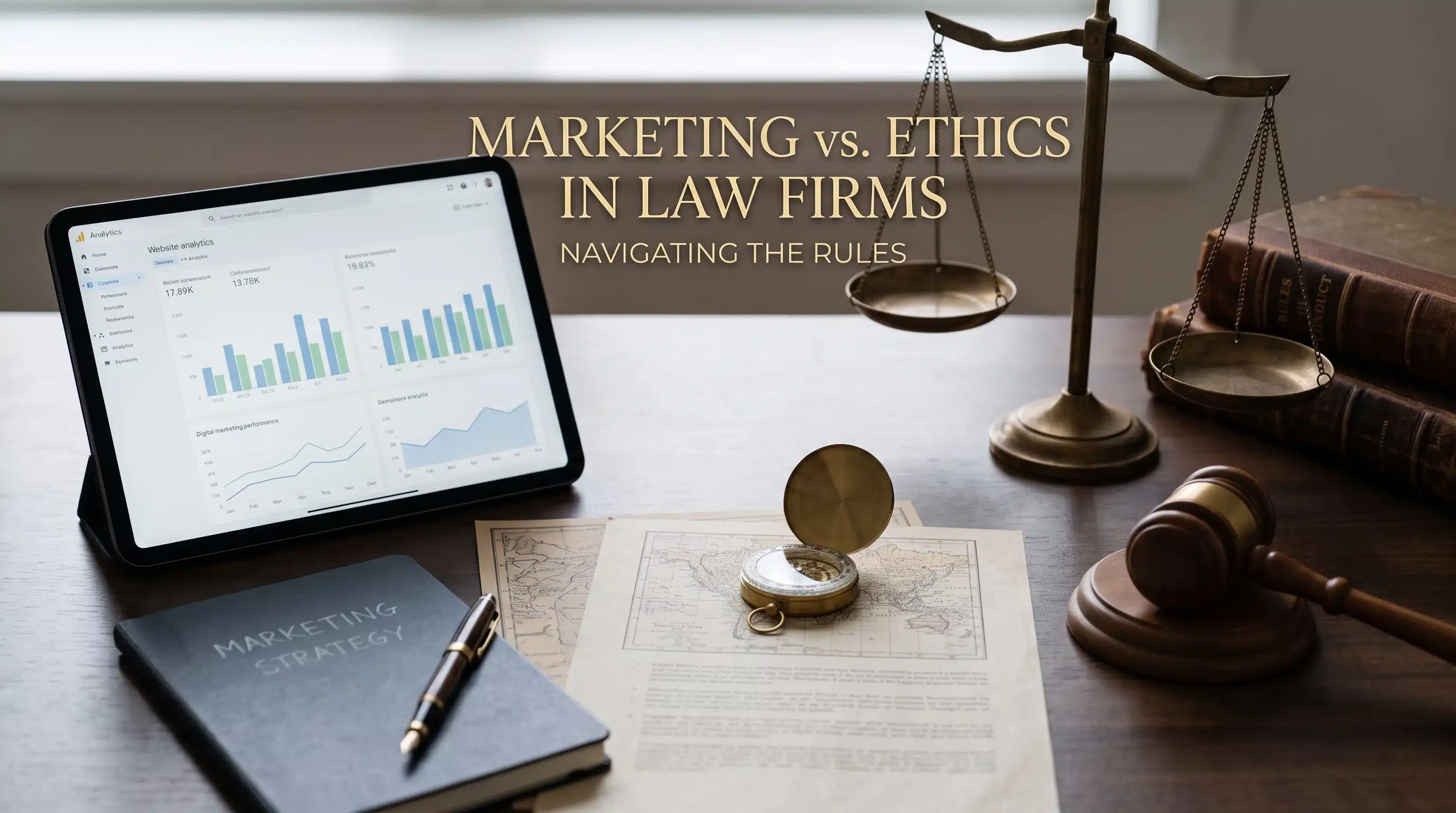
Every law firm marketing decision runs through the same tension: what drives clients through the door is often exactly what bar ethics rules are most skeptical of: bold claims, compelling testimonials, aggressive lead generation. Firms that ignore this tension either market too cautiously to compete, or market aggressively and take on real bar discipline risk without realizing it until a complaint arrives.
This guide is the complete framework: what the rules actually say, where states diverge, and where the real risk sits in 2026’s marketing landscape specifically. Our team at DiscoverMyBusiness works with law firms building marketing programs that compete hard without stepping on these lines.
Get a Free Compliance-Aware Marketing Review →
Why This Tension Actually Matters
Bar discipline for advertising violations ranges from a quiet letter requiring a correction to formal sanctions, but the more common cost is less dramatic and more expensive over time: firms that under-market out of vague ethics anxiety lose client volume to competitors who’ve actually done the work of understanding where the real lines are. The goal of this guide isn’t caution for its own sake. It’s precision, so your firm can market at full intensity within rules you actually understand rather than rules you’re guessing at.
The Core Framework: ABA Model Rules 7.1–7.3
The American Bar Association’s Model Rules of Professional Conduct on advertising, Rules 7.1 through 7.3, form the template most states build their own attorney advertising rules from. (Before the ABA’s 2018 revision, the series ran 7.1 through 7.5. Rule 7.4 on specialization and Rule 7.5 on firm names were deleted, with specialization moved into Rule 7.2(c) and firm-name guidance moved into the comments to Rule 7.1.) “Model” is the operative word. States adopt these as a starting point, then modify, renumber, or add requirements on top, and some states, including New York with its Rule 7.5 on firm names, still maintain standalone rules. This is the single most important thing to understand before reading any general guide to these rules, including this one: always confirm your specific state’s current rule numbering and text before relying on the Model Rule framework alone.
Rule 7.1: False or Misleading Communications
Rule 7.1 is the foundational rule almost every other advertising restriction traces back to: a lawyer cannot make a false or misleading communication about themselves or their services. This covers:
- Material misrepresentations of fact or law: straightforwardly false claims
- Misleading omissions: a statement that’s technically true but misleading because of what it leaves out
- Statements creating unjustified expectations: language implying a guaranteed or predictable outcome
- Unsubstantiated comparisons: claims of being “the best” or “better than” without factual basis a reasonable person could verify
State versions of this rule can differ, and they change. New York, for example, replaced its detailed advertising rules with a streamlined, ABA-style Rule 7.1 effective June 1, 2026, and dropped its former mandatory “Prior results do not guarantee a similar outcome” disclaimer and “Attorney Advertising” labeling requirements. The core standard against false, misleading, or deceptive communications still applies, so keeping a results disclaimer remains good practice.
Rule 7.2: Paying for Referrals and Lead Generation
Rule 7.2 permits lawyers to advertise through any media (print, broadcast, digital, social) but prohibits giving anything of value to someone for recommending your services. This is the rule that most directly governs lead generation, legal directories, and referral arrangements, and it’s where firms most commonly get the structure wrong without realizing it.
- Permitted: paying the reasonable cost of advertising itself (a directory listing fee, ad spend, a flat administrative fee for lead qualification work)
- Generally prohibited: paying a percentage of the eventual settlement or fee as compensation for a referral or lead
- Permitted with conditions: fee divisions between lawyers at different firms under Rule 1.5(e): proportional to work performed or with joint responsibility, client written consent, and a reasonable total fee
- California’s specific interpretation: a flat fee for a directory listing is treated as permissible, while a per-referral fee structure is treated differently. This distinction has direct implications for how pay-per-lead arrangements should be structured
The practical test that holds up across most state variations: is the fee paid for the work of generating or qualifying the lead (generally fine), or is it effectively a commission on the referral itself, especially one tied to case value (generally not fine)?
Rule 7.3: Solicitation Restrictions
Rule 7.3 restricts in-person, live telephone, or real-time electronic solicitation of a specific person known to need legal services in a particular matter, when a significant motive is the lawyer’s own pecuniary gain and no family, close personal, or prior professional relationship exists. This is the rule most relevant to aggressive lead-generation follow-up: a service that contacts a captured lead in a way that implies an attorney is personally recommending or soliciting them can implicate this rule, separate from whether the lead itself was generated compliantly under Rule 7.2.
Specialization and Certification Claims
Claims of being a “specialist” or “certified” in a practice area are restricted. Generally, these claims require actual certification by an organization accredited for that purpose (such as a state bar-approved certifying body), not just years of experience or a self-declared focus area. “Practice areas” or “focus areas” language avoids this restriction; “specialist” or “certified” language without the underlying credential does not.
Firm Names, Trade Names, and Branding
Rules governing firm names generally require that a firm’s name not be misleading. A trade name implying a connection to a government agency or a nonexistent partnership structure is a common violation pattern. This matters increasingly for firms building a consumer-facing brand name distinct from the named-partner structure of the underlying legal entity; the brand name still has to clear the same non-misleading standard as any other communication.
Testimonials, Reviews, and Case Results
This is one of the highest-risk, highest-value areas of legal marketing, because testimonials and case results are genuinely persuasive and genuinely regulated. Collecting and displaying reviews the right way is the foundation of any online reputation management program.
- Testimonials cannot imply guaranteed or typical results: a testimonial describing an exceptional outcome generally needs a disclaimer clarifying that results vary by case
- Disclaimers must be clear, plain-language, and placed immediately adjacent to the claim: a disclaimer buried in a footer disconnected from the testimonial it’s meant to qualify doesn’t satisfy the requirement
- A disclaimer cannot cure an untrue underlying claim: if the claim itself is false or misleading, adding a disclaimer doesn’t make it compliant
- Florida-specific practice tip: Florida Bar Rule 4-7.20 exempts certain basic advertisements from the filing requirement, namely those limited to the information listed as presumptively valid in Rule 4-7.16, such as the lawyer’s name, office location, phone number, and field of law. Adding information beyond that list (a testimonial or case result, for example) generally takes the advertisement outside that exemption. A lawyer’s own website is separately exempt from filing under Rule 4-7.20(g), but it must still comply with the substantive advertising rules
- Federal overlay: the FTC’s Consumer Reviews and Testimonials Rule, effective October 2024, adds federal civil penalty exposure for fake, false, or suppressed reviews, on top of, not instead of, state bar rules
State-by-State Variation: What Actually Changes
| State | Notable points compared with the baseline Model Rules |
|---|---|
| California | No mandatory disclaimer requirement at the rule level for testimonials/past results, but State Bar ethics opinions (including Formal Opinion 2016-196) address online reviews and social media endorsements specifically; distinguishes flat directory fees from per-referral fee structures |
| New York | Effective June 1, 2026, replaced its detailed advertising rules with a streamlined, ABA-style Rule 7.1 and eliminated the mandatory “Prior results do not guarantee a similar outcome” disclaimer and “Attorney Advertising” labeling; Rule 7.2 on payment for referrals is unchanged, and New York keeps its own Rule 7.5 on firm names |
| Florida | Keeps a filing-and-review system: advertisements generally must be filed at least 20 days before first use (Rule 4-7.19), with exemptions under Rule 4-7.20 for basic advertisements limited to the content listed in Rule 4-7.16 and, separately, for a lawyer’s own website (which must still comply with the substantive rules) |
This table covers three commonly cited examples, not a comprehensive 50-state breakdown. Treat state-specific rule confirmation as a required step, not an optional one, before launching any campaign involving testimonials, case results, or lead-generation arrangements.
Modern Compliance Risks in 2026
AI-generated marketing content
AI-generated content isn’t categorically prohibited, but current ABA ethics guidance places responsibility for its accuracy squarely on the supervising attorney. The primary risk is factual inaccuracy (a hallucinated case citation or an incorrectly described result), which creates direct Rule 7.1 exposure if published without review. A mandatory attorney sign-off before any AI-generated marketing content goes live is the standard, expected mitigation.
Pay-per-lead and pay-per-signed-case models
Compliance here depends entirely on structure. A flat fee covering the administrative cost of qualifying a lead is generally permissible; a fee calculated as a percentage of the eventual settlement functions as a prohibited referral fee under Rule 7.2, regardless of how the arrangement is labeled. Every case still needs independent attorney review before the attorney-client relationship is considered established, regardless of how the lead was sourced.
TCPA and telemarketing overlap
The Telephone Consumer Protection Act requires prior express written consent before contacting potential leads using automated dialing systems or prerecorded voice messages. This is a federal requirement layered on top of, and independent from, state bar solicitation rules. Violations carry statutory damages of up to $1,500 per willful occurrence, making intake form consent language a real compliance requirement, not boilerplate. The same consent discipline applies to any SMS marketing follow-up.
Building a Compliant Marketing Review Process
- Confirm your specific state’s current rules before assuming Model Rule text applies as written. Check your state bar’s current rule numbering and any relevant ethics opinions
- Require attorney sign-off on all claims-bearing content: testimonials, case results, comparative statements, and any AI-assisted marketing copy
- Separate “advertising cost” from “referral compensation” explicitly in any lead-generation or directory contract, and confirm the fee structure doesn’t scale with case value
- Pair every testimonial or case result with an adjacent, plain-language disclaimer clarifying that results vary by case
- Document lead consent properly for any automated contact method, satisfying both bar rules and TCPA requirements
- Review annually, not just at launch. State ethics opinions and federal rules like the FTC’s testimonials rule continue to evolve
Where to Start
If you only address one thing from this guide this week, audit your existing testimonials and case results pages specifically. This is the highest-visibility, most commonly non-compliant content on most law firm websites, and it’s usually the fastest to fix with a proper disclaimer and a review against your state’s specific filing requirements. Folding that review into a broader marketing strategy keeps it from being a one-time fix.
Key Takeaways
- The Model Rules are a starting template, not a final answer. State-specific confirmation is required, not optional
- The test for referral fees is function, not label: is it paying for the work, or a commission on the outcome?
- Testimonials need adjacent, plain-language disclaimers, and a disclaimer can’t fix an underlying false claim
- AI content, pay-per-lead structures, and TCPA consent are the three biggest 2026-specific risk additions on top of the base ethics framework
Frequently Asked Questions
1. Can law firms advertise on Google and social media?
Yes. ABA Model Rule 7.2 explicitly permits advertising through any media, including paid search and social platforms, as long as the content itself complies with Rule 7.1’s truthfulness standard.
2. Is it ever okay to pay for referrals?
Generally no as a direct commission, but paying the reasonable cost of advertising, a flat directory listing fee, or structuring a compliant fee division under Rule 1.5(e) between lawyers at different firms are permitted paths that accomplish similar goals within the rules.
3. Do client testimonials need a disclaimer?
Generally yes, especially for testimonials describing case outcomes. A plain-language disclaimer noting that results vary by case, placed immediately adjacent to the testimonial, is the standard practice across most states.
4. Can I call my firm a “specialist” in a practice area?
Only if backed by actual certification from an accredited certifying organization in most states. Years of experience or a stated focus area alone generally doesn’t satisfy the “specialist” or “certified” claim standard.
5. Is AI-generated marketing content allowed for law firms?
Yes, it’s not categorically prohibited, but the supervising attorney remains responsible for its accuracy under current ABA guidance. A mandatory review step before publishing is the expected safeguard against Rule 7.1 exposure from inaccurate AI output.
6. Are pay-per-lead services ethical for law firms to use?
It depends entirely on the fee structure. Flat fees for lead qualification work are generally permissible, while fees calculated as a percentage of settlement value generally are not, regardless of how the arrangement is described in the contract.
7. Do these rules differ significantly by state?
Yes, meaningfully. Some states have recently moved toward the Model Rules (New York streamlined its rules effective June 2026), others keep a filing-and-review system with specific exemptions and triggers (Florida), and others address emerging areas like online reviews through ethics opinions rather than rule text (California).
8. What’s the biggest marketing compliance risk for law firms right now?
Testimonials and case results without adequate, properly placed disclaimers remain the most common and highest-visibility violation, closely followed by lead-generation arrangements structured as disguised referral commissions.
Want Your Law Firm’s Marketing Reviewed for Compliance Gaps?
Get a free review of your website, testimonials, and lead-generation setup against your state’s specific advertising rules.
(877) 522-7738
Blogs
Enterprise SEO: How Large Websites Can Scale Rankings Effectively
Large websites don’t win by fixing pages one at a time. Learn how enterprise SEO scales rankings through crawl control, template fixes, safe content scaling and AI search readiness.
How to Customize Sales Popups on Shopify to Match Your Brand
Learn how to customize sales popups on Shopify to match your brand, from colors, fonts, and position to message text, timing, and mobile testing.
How Shopify Sales Notifications Help Build Social Proof and Increase Sales
Learn how Shopify sales notifications build social proof, reduce shopper hesitation, and support sales, plus best practices and how to add them to your store.
Franchise SEO Challenges and How Multi-Location Brands Can Overcome Them
Franchise SEO is mostly a coordination problem. See the 10 challenges multi-location brands face, from duplicate location pages and listing drift to profile ownership and AI search, and how to fix each one at scale.
Google Ads Benchmarks 2026: What the Numbers Actually Mean for Your Account
Google Ads Search averages for 2026 are a 6.64% CTR, $5.42 CPC, 8.18% conversion rate and $66.69 cost per lead. Learn how to find your break-even CPL and which metric is holding your account back.
Best Shopify Sales Popup Apps to Boost Customer Trust and Conversions
Compare seven Shopify sales popup apps on features, customization, pricing, and ease of use, and learn how to pick one that builds trust without guesswork.
Franchise vs Enterprise Digital Marketing: Key Differences & Best Practices
Franchise and enterprise marketing both manage many locations under one brand, but they run on different rules. See who controls the budget, brand and data in each model, and the best practices that work for both.
How to Add a Shopify Sales Popup: Step-by-Step Guide
Learn how to add a Shopify sales popup in seven steps. Pick an app, set display rules, test on mobile, and track whether it works, with no coding needed.
Google Partner Rewards Store Not Working? We Hit a Redirect Loop, and Here’s What to Do
Stuck in a Google Partner Rewards Store redirect loop? Discover the exact causes behind the login bug and practical troubleshooting steps to redeem your partner points.
GloriaFood Is Shutting Down: Your 7-Step Plan and a Replacement to Try
With Oracle discontinuing GloriaFood, restaurants must plan ahead: explore a 7-step migration blueprint, data export tips, and top online ordering replacements.
Best Shopify Image Optimization Apps: How to Choose the Right Tool for Your Store
Learn what to look for in a Shopify image optimization app, the main types of tools, how to compare apps fairly, and the mistakes to avoid when choosing the right one.
Shopify Image Optimization Checklist: What to Do Before and After Uploading Product Photos
Use this Shopify image optimization checklist to prepare product photos before you upload, finish the job after, avoid common mistakes, and handle large catalogs in bulk.
Beehiiv Newsletter Platform: Pricing, Features, and Monetization Tools
Explore the beehiiv newsletter platform to streamline your communication and engage with your audience effectively.
Shopify Core Web Vitals and Images: How to Find and Fix Image-Related Speed Issues
Learn how images affect Shopify Core Web Vitals, how to find image-related speed issues, the most common mistakes, and how to fix them, including for large product catalogs.
Shopify Fake Cart Bot Attack: What Stopped 500+ Fake Carts an Hour (and a Script We Can’t Rule Out)
A client’s Shopify store was hit with 500+ fake carts an hour, and captchas, rate limits and bot apps didn’t stop it. Here’s why the traffic bypassed our security, the one fix that worked, and a third-party script lead we’re still tracing.
Getting information about your case and your options is your FIRST move. Get a FREE case evaluation now…
Find Yourself a Marketing Expert Near You!
(877) 522-7738