
Lead Management vs. Lead Generation: What’s the Actual Difference?
TL;DR:
- Lead generation is everything that gets a prospect's information into your pipeline: SEO, PPC, content, forms, landing pages.
- Lead management is everything that happens after that: qualifying, scoring, routing, nurturing, and following up on the leads you already have.
- They're not competing strategies. They're sequential halves of the same funnel, and most businesses are only investing in one of them.
- This matters for your budget: spending more on generation while your management process leaks leads is the single most common way marketing dollars get wasted.
"Lead generation" and "lead management" get used almost interchangeably in a lot of marketing content, and that's a problem, because they're solving two completely different failures. If your pipeline is full but your close rate is flat, more lead generation won't fix that. You have a management problem. If your sales team has plenty of time and a clean process but nothing to work with, more management tooling won't fix that either. You have a generation problem.
Knowing which one you actually have is the difference between fixing the real issue and throwing more budget at the wrong half of the funnel. Our lead generation services team builds both halves for clients, and this is usually the first thing we diagnose. Here's the actual difference, and how to tell which one you're missing.
Get a Free Lead Funnel Audit →
What Is Lead Generation?
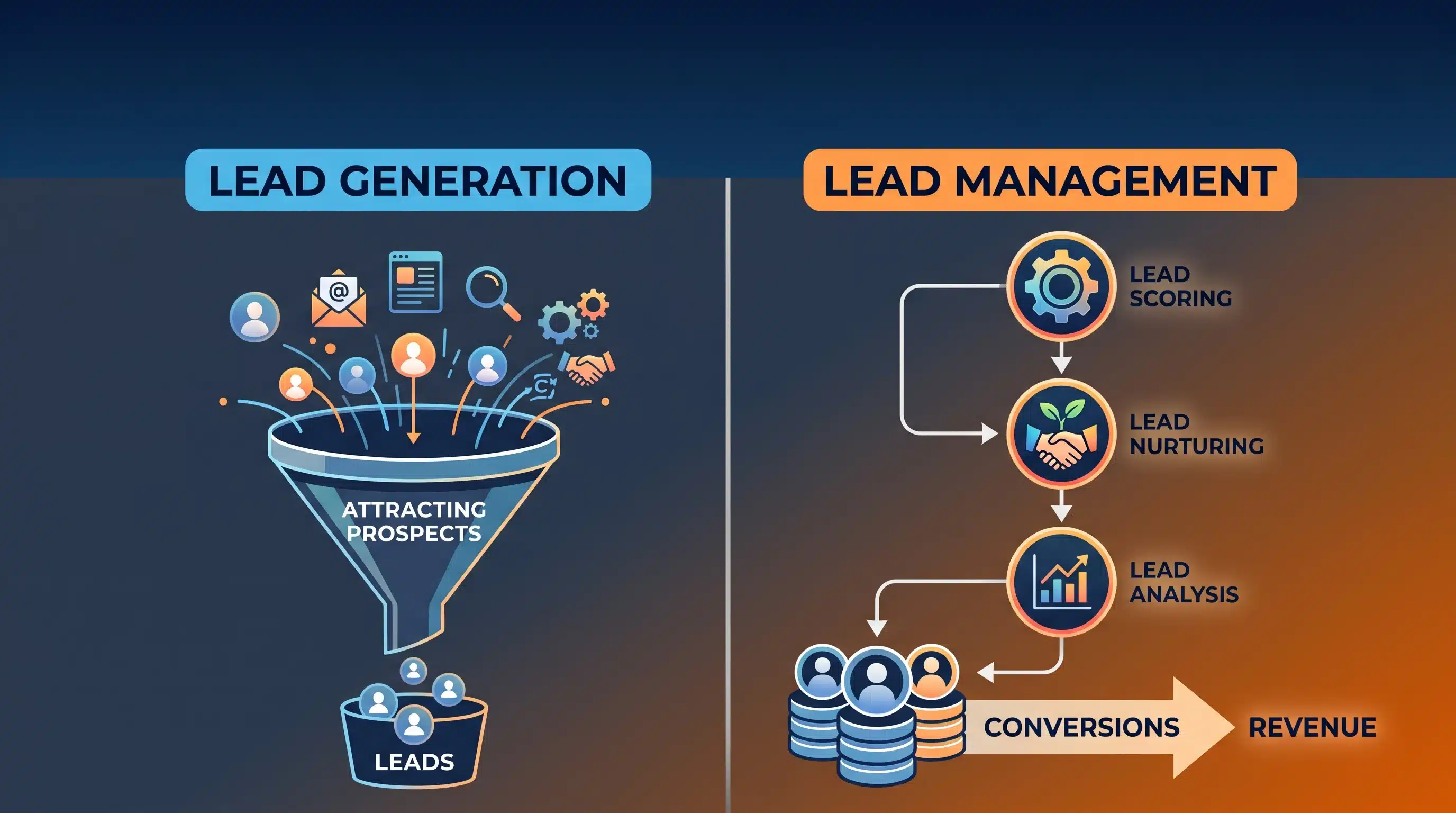
Lead generation is the set of activities that attract prospects and capture their information for the first time, turning an anonymous visitor into a named lead your business can follow up with.
- Attraction channels: SEO, PPC, social media, content marketing, and paid social all designed to bring the right people to your site
- Capture mechanisms: landing pages, forms, gated content, chatbots, and calls-to-action that turn a visitor into a lead
- Volume and cost metrics: cost per lead, conversion rate, traffic quality: the KPIs that tell you whether the top of the funnel is healthy
- Ownership: almost always sits with marketing
In short: lead generation's job ends the moment a name and contact detail land in your CRM. What happens next is a different discipline entirely.
What Is Lead Management?
Lead management is everything that happens to a lead after it's been captured: qualifying it, scoring it, routing it to the right person, nurturing it if it's not ready to buy, and tracking it through to a closed deal or a clear disqualification.
- Qualification and scoring: determining which leads are worth pursuing now, later, or not at all
- Routing and distribution: getting each lead to the right salesperson or team quickly, before interest cools
- Nurturing: follow-up sequences, retargeting, and content for leads who aren't ready to buy yet
- Tracking and reporting: visibility into where every lead sits in the pipeline and why some stall
- Ownership: usually split between marketing (nurturing) and sales (qualification, follow-up), which is exactly where things tend to fall through the cracks
In short: lead management's job is making sure a captured lead doesn't just sit there. A lead that never gets contacted is functionally the same as a lead that was never generated, except it cost you money to acquire.
Lead Generation vs. Lead Management: Side-by-Side
| Lead Generation | Lead Management | |
|---|---|---|
| Goal | Fill the pipeline with new prospects | Convert the pipeline you already have |
| Primary metrics | Cost per lead, traffic, conversion rate | Response time, lead-to-close rate, pipeline velocity |
| Typical owner | Marketing | Sales, sometimes shared with marketing |
| Core tools | SEO, PPC, landing pages, forms | CRM, lead scoring, automated follow-up, dialers |
| Failure mode | Not enough leads coming in | Plenty of leads, but they go cold or unworked |
How the Two Work Together in a Real Funnel
Think of it as one continuous handoff: lead generation fills the top of the funnel, and lead management determines how much of what comes in actually reaches the bottom. A business can be excellent at one and still lose because the other side is broken. Strong generation with weak management just produces an expensive pile of leads nobody follows up with, and strong management with weak generation produces a fast, well-organized process with nothing to run through it.
This is also why the two are almost never a fair "vs." comparison in practice. The real question isn't which one matters more, it's which one is currently the bottleneck in your specific funnel.
Signs Your Lead Generation Is Weak
- Sales has capacity to spare and is asking for more leads, not more time
- Traffic is flat or declining across your main acquisition channels
- Cost per lead is climbing without a corresponding increase in lead quality
- Your pipeline depends heavily on one channel and that channel's performance has started to slip
Signs Your Lead Management Is Weak
- Leads sit for hours or days before first contact. Response time is one of the strongest predictors of conversion, and it's the first thing to slip when management is weak
- No consistent scoring or qualification process exists, so reps spend equal time on hot and cold leads
- Marketing and sales disagree on what counts as a "good" lead and there's no shared definition
- Leads that aren't ready to buy simply disappear instead of entering a nurture sequence
- You can generate more leads than your team can properly follow up on: the classic sign of a generation-management mismatch
How to Strengthen Both Sides of the Funnel
- Diagnose before you spend: pull your lead-to-close rate and average response time before deciding which side needs investment
- Define a shared lead scoring model: get marketing and sales aligned on what qualifies as sales-ready before adding more volume
- Fix response time first if it's slow: this is usually the highest-ROI management fix available, and it's often a process problem, not a tooling one
- Build a real nurture path for "not yet" leads: most lost leads aren't disqualified, they're just never followed up with again
- Only then scale generation: once qualification, routing, and nurturing are solid, additional lead volume actually converts instead of piling up unworked
Tools Commonly Used for Each
| Function | Lead generation tools | Lead management tools |
|---|---|---|
| Capture | Landing page builders, form tools, chatbots | N/A |
| Qualification | N/A | Lead scoring within a CRM, intent data platforms |
| Follow-up | N/A | Automated call/SMS/email sequences, sales dialers |
| Nurturing | Retargeting ads, drip email campaigns | CRM-based nurture workflows, lifecycle marketing automation |
Our own automated calls, SMS, and email follow-up tools sit squarely on the management side of this table, which is exactly the gap most lead generation-only strategies leave open.
Which One Should You Invest In First?
If you have to pick one to fix first, fix management. A business with a broken management process wastes money on every single lead it generates, while a business with a broken generation process at least wastes nothing; it simply isn't growing yet. Fixing management first means every dollar you spend on generation after that actually has a chance to convert.
Key Takeaways
- They're sequential, not competing: generation fills the pipeline, management works it
- Response time is the tell: slow first contact is the clearest sign of a management gap
- Scaling generation with weak management wastes budget: more leads into a broken process just means more waste, faster
- Fix qualification and follow-up before adding volume: it's almost always the higher-leverage fix
Frequently Asked Questions
1. Is lead management part of lead generation, or a separate process?
They're separate but connected processes. Lead generation ends once a lead is captured; lead management begins immediately after and continues until the lead is closed or disqualified.
2. Which department should own lead management?
It's typically shared: marketing owns nurturing for leads that aren't sales-ready, and sales owns qualification and direct follow-up. The handoff point between the two needs to be clearly defined, or leads fall through the gap.
3. What's the biggest mistake businesses make with these two?
Investing more in lead generation while an existing management problem, usually slow response time or inconsistent follow-up, quietly wastes a growing share of every new lead that comes in.
4. How fast should a new lead be contacted?
Response time is one of the strongest predictors of conversion, and the drop-off after the first several minutes is steep. Faster is almost always better, and automated first-touch follow-up is a common way to close that gap.
5. Can a small business have good lead management without a CRM?
It's possible at very low volume, but it doesn't scale. Without a system to track status and trigger follow-up automatically, leads get missed as volume grows, even with a diligent team.
6. Does lead scoring require a lot of historical data to work?
No. A simple scoring model based on firmographic fit and engagement behavior can work from day one; it gets more precise over time as more closed-deal data comes in, but it doesn't need to wait for that.
7. Is a "lead management system" the same thing as a CRM?
A CRM is usually the platform lead management runs on, but the system itself (scoring rules, routing logic, nurture sequences) is the process built on top of the CRM, not the software alone.
8. How do I know if my lead generation and lead management are actually balanced?
Compare your lead volume to your sales team's realistic follow-up capacity, and check your lead-to-close rate over time. A widening gap between leads generated and leads actually worked is the clearest signal of imbalance.
Not Sure Which Side of Your Funnel Is Leaking?
Get a free audit of your lead generation and lead management process to find out exactly where leads are being lost.
(877) 522-7738
Blogs
How to Validate Shopify Structured Data
Learn how to validate Shopify structured data with Google’s Rich Results Test, Schema Markup Validator, and Search Console to find and fix common schema errors step by step.
JSON-LD vs. Microdata: Differences for Shopify
Compare JSON-LD vs. Microdata for Shopify. Learn how each format works, which is easier to maintain, how they handle Product Schema, and how to validate your structured data.
Imagify for WordPress: Features, Pricing & a $6/Month Deal for 1,000 MB (2026)
Imagify for WordPress automatically compresses images, converts them to WebP/AVIF, and improves site speed with off-server optimization.
Is $10 a Day Enough for Google Ads? A Realistic Breakdown
A $10-a-day Google Ads budget works only when tightly targeted to local, low-CPC niches, while competitive industries require higher spend for data learning.
Filevine Case Management: Top Benefits for Growing Law Firms
Filevine case management software offers powerful AI tools and deep customization, making it ideal for high-volume personal injury and litigation firms.
Shopify Review Schema: Ratings and Structured Data
Learn how Shopify review schema works, how to add ratings and reviews to Product JSON-LD, validate markup, and fix common structured data issues.
SMBMarket Review 2026: Is It Worth $67/Mo for Business Buyers?
SMBMarket aggregates business-for-sale listings, deal tools, and coaching for $67 a month, serving as a consolidated platform for prospective business buyers.
How to Fix Missing validFrom in Merchant Listings
Learn how to fix missing validFrom errors in Google Merchant Listings, when the property is required, how to add it to Shopify JSON-LD, and how to validate the fix.
Shopify Product Schema vs. Google Merchant Listings
Shopify Product Schema vs. Google Merchant ListingsNEED HELP? CONTACT US 24/7 (877) 522-7738 Industries We Serve Law Firms & Legal Services Healthcare & Medical Practices Technology & SaaS Companies E-Commerce & Retail Home Service Finance Free...
How Many Billable Hours Does a Home Care Agency Need to Hire a Marketing Agency?
Instead of relying on a universal billable hours benchmark, home care agencies should determine marketing readiness using their margin per hour, payer mix, and operational capacity.
AppLovin Ads: Features, Pricing & Mobile App Advertising
AppLovin Ads: Features, Pricing & Mobile App AdvertisingNEED HELP? CONTACT US 24/7 (877) 522-7738 Industries We Serve Law Firms & Legal Services Healthcare & Medical Practices Technology & SaaS Companies E-Commerce & Retail Home Service Finance Free...
Gushwork: AI SEO, GEO, Pricing, Features & Alternatives
Gushwork: AI SEO, GEO, Pricing, Features & AlternativesNEED HELP? CONTACT US 24/7 (877) 522-7738 Industries We Serve Law Firms & Legal Services Healthcare & Medical Practices Technology & SaaS Companies E-Commerce & Retail Home Service Finance Free...
Shopify Rich Snippets: Setup and Troubleshooting
Shopify Rich Snippets: Setup and Troubleshooting ============================================================================ Shopify Rich Snippets: Setup and Troubleshooting (new DMB design) Main link (plain, same attributes as the other pages):...
How to Add Product Schema to Shopify
How to Add Product Schema to Shopify: A Step-by-Step GuideNEED HELP? CONTACT US 24/7 (877) 522-7738 Industries We Serve Law Firms & Legal Services Healthcare & Medical Practices Technology & SaaS Companies E-Commerce & Retail Home Service Finance Free...
Before You Pay $10K+/Month for Personal Injury SEO, Ask This Exclusivity Question
Because local search rankings are zero-sum, personal injury law firms must verify agency exclusivity in their geographic market before committing to costly SEO retainers.
Getting information about your case and your options is your FIRST move. Get a FREE case evaluation now…
Find Yourself a Marketing Expert Near You!
(877) 522-7738