
Case studies / eCommerce
Restricted category · Merchant Center & CROMost of the catalogue was ineligible. Not all of it was.
King Buddha sells hemp-derived CBD and THC products: a category where Google and Meta prohibit most of what's on the shelf. Rather than write the channel off, we separated the catalogue by eligibility, proved the compliant products with lab documentation, and got them approved.
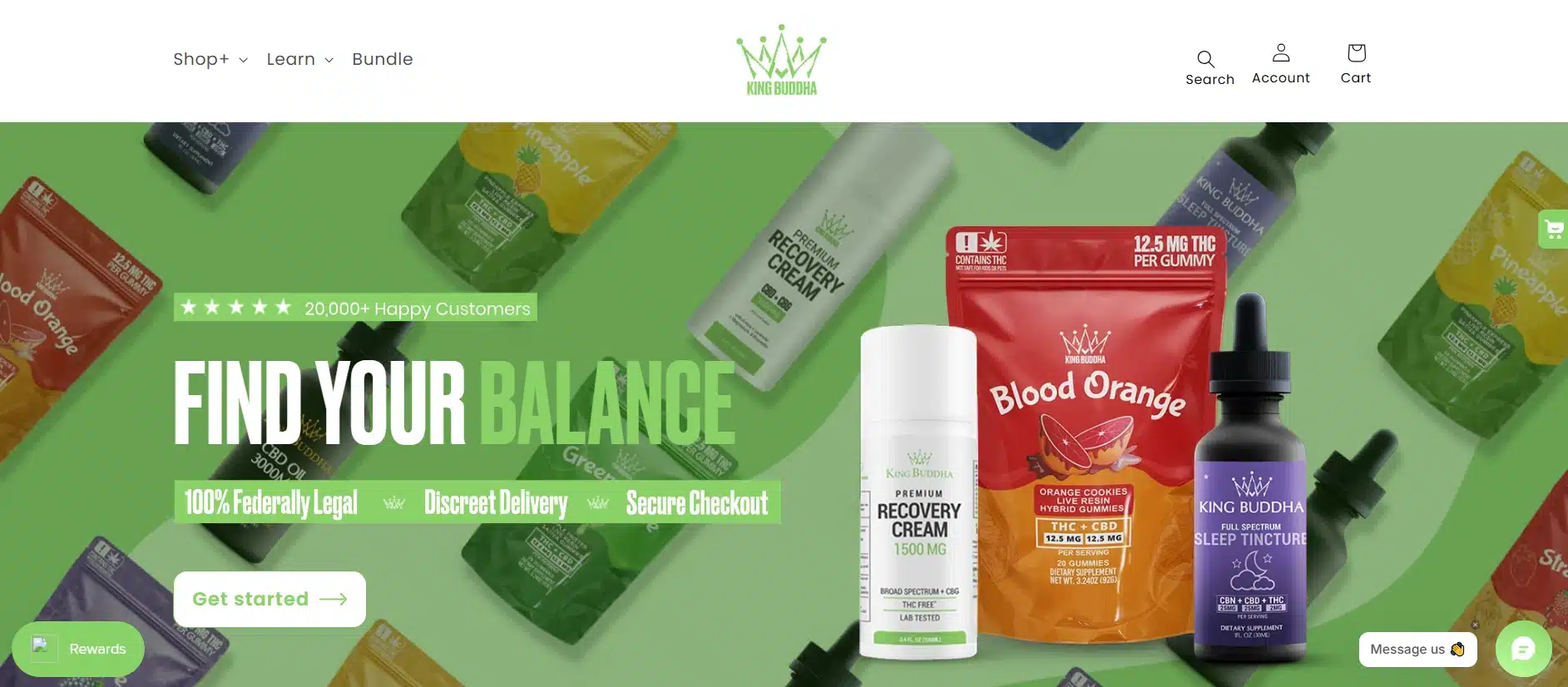
A hemp brand selling in one of the most restricted ad categories.
King Buddha sells hemp-derived CBD and THC products, including gummies, tinctures, topicals, cookies and pre-rolls, compliant with the 2018 Farm Bill and third-party lab tested.
Legal to sell nationwide, but largely ineligible to advertise on the platforms most ecommerce brands rely on, which meant the growth plan had to look different from the start.
A restricted category isn't a uniformly restricted catalogue.
Brands in cannabis-adjacent categories learn early that Google and Meta won't take them, and most stop there. The whole channel gets written off as closed. But the policies restrict specific product characteristics, not the company selling them. Within a catalogue that looks entirely ineligible, there are usually products that aren't.
Write off the channel and move on.
The reasonable conclusion after the first rejection. It's also how a brand ends up with no presence on the largest shopping surface in ecommerce, permanently, including for the products that would have been eligible all along.
- Products submitted None
- Approved None
- Shopping presence Zero
- Opportunity Never tested
Find the compliant products and prove them.
Audit the catalogue product by product against the policy, separate what qualifies from what doesn't, and support the eligible items with the documentation Google asks for: third-party lab results establishing cannabinoid content.
- Catalogue Split by eligibility
- Evidence Third-party COAs
- Approved THC-free SKUs
- Shopping presence Established
The default channels were unavailable.
King Buddha sells hemp-derived products across gummies, tinctures, topicals, cookies and pre-rolls, compliant with the 2018 Farm Bill and third-party lab tested.
Legal to sell. Largely ineligible to advertise. That combination defines the whole problem.
-
Ingestibles are prohibited regardless of legality
Google's policies permit certain topical, non-ingestible hemp-derived CBD products, subject to certification and state restrictions. Ingestible CBD and any THC-containing product sit outside that. Being federally legal under the Farm Bill doesn't change advertising eligibility: those are separate systems with separate rules.
-
The product claims that sell are the claims that flag
Cannabinoid marketing reaches naturally for language about sleep, pain, stress and mood. Every one of those touches the boundary of a health claim, and in a restricted category the tolerance is lower than in supplements.
-
Paid media options are limited and unfamiliar
The networks that do accept cannabis and CBD advertising exist, but most agencies have never used them. Without them, a brand in this category has organic, owned audience and wholesale, and nothing else.
-
Every visitor has to count for more
When you can't buy traffic at scale, conversion rate stops being an optimisation and becomes the primary growth lever. The same number of visitors has to produce more orders, because there's no way to simply buy more visitors.
Four things, none of them a workaround.
In a category this scrutinised, the only durable approach is the compliant one. Accounts built on anything else don't survive a policy review.
Audit the catalogue product by product
We went through the SKUs individually against Google's policy rather than treating the brand as a single eligibility question. Cannabinoid content, product format and claims language all determine whether a specific item can be listed, and the answer differs across a catalogue that looks uniform from the outside.
A clear line between what could be submitted and what couldn't.
Submit the eligible products with lab documentation
Merchant Center SKUs rebuilt for the THC-free products, with third-party lab results submitted to Google as verification of cannabinoid content. Documentation is what moves a product from "probably fine" to approved in a category where the reviewer's default position is rejection.
Compliant products approved and serving on Google Shopping.
Run paid media on a network that permits the category
For everything that couldn't run on mainstream platforms, we used Mantis, an ad network built specifically to serve cannabis and CBD advertisers. It exists because the major platforms won't take these brands, and most agencies working outside the category have never heard of it.
Paid traffic to the store, on a network where the products are permitted.
Make every visitor count for more
With traffic volume constrained by the category, conversion rate became the main lever. Site optimisation, promotional offer structure, product page improvements and checkout refinement, all aimed at converting more of the traffic that could actually be reached.
A 25% improvement in conversion rate.
A 25% lift is worth more here than anywhere else.
In an unrestricted category, a 25% conversion improvement is a good quarter's work. You'd take it, and then you'd go and buy more traffic, because that's the faster path to growth.
When you can't buy more traffic, conversion rate is the growth channel. A 25% lift works out the same as increasing traffic by a quarter, except it costs nothing per visit and it compounds across every channel at once.
That changes what you prioritise. Offer structure, product page clarity, trust signals and checkout friction stop being incremental improvements and become the main work. A restricted-category brand that hasn't invested seriously in conversion rate is leaving its only unconstrained lever untouched.
The same logic applies to owned audience
It's why brands in this category invest disproportionately in the things they control: email and SMS lists, rewards programmes, affiliate networks, wholesale and white-label channels, and organic content. Not because those are trendy, but because a customer you already have is a customer you don't need permission to reach.
Restricted categories force a discipline most ecommerce brands never develop, because most brands can solve a growth problem by raising a budget, and these ones can't.
Four things for any restricted category.
Check eligibility per product, not per brand
Policies restrict product characteristics, not companies. A catalogue that looks entirely blocked often contains items that qualify, and nobody finds them by assuming.
Documentation is the approval route
In scrutinised categories, third-party lab results and certifications are what move a reviewer. Submitting without evidence is asking someone to take your word in a category where their default is no.
Learn the networks that accept you
Compliant ad networks exist for most restricted categories. They're smaller and less familiar, and they're the difference between having paid media and having none.
Conversion rate becomes the growth channel
When traffic is capped by policy rather than budget, improving conversion is the only lever that scales. Treat CRO as primary, not as a tidy-up.
What went into it.
Seven of our services, on one account.
Told your whole category is blocked?
It's worth checking whether that's true of every product you sell. Give us read-only access and we'll tell you which SKUs could be eligible, what documentation would be needed, and which compliant networks are open to you. Findings are yours to keep either way.
Read-only access · No obligation · You keep your accounts