
Case studies / Legal
DWI defence · North TexasWe were given $5,000 a month. We couldn't spend it.
Two narrow practice areas across seven North Texas counties produces a finite number of searches per month. Spending the full budget would have meant buying traffic outside the counties the firm served or outside the cases it wanted. So we didn't, and said so every month.
We were given $5,000 a month. We couldn't spend it.
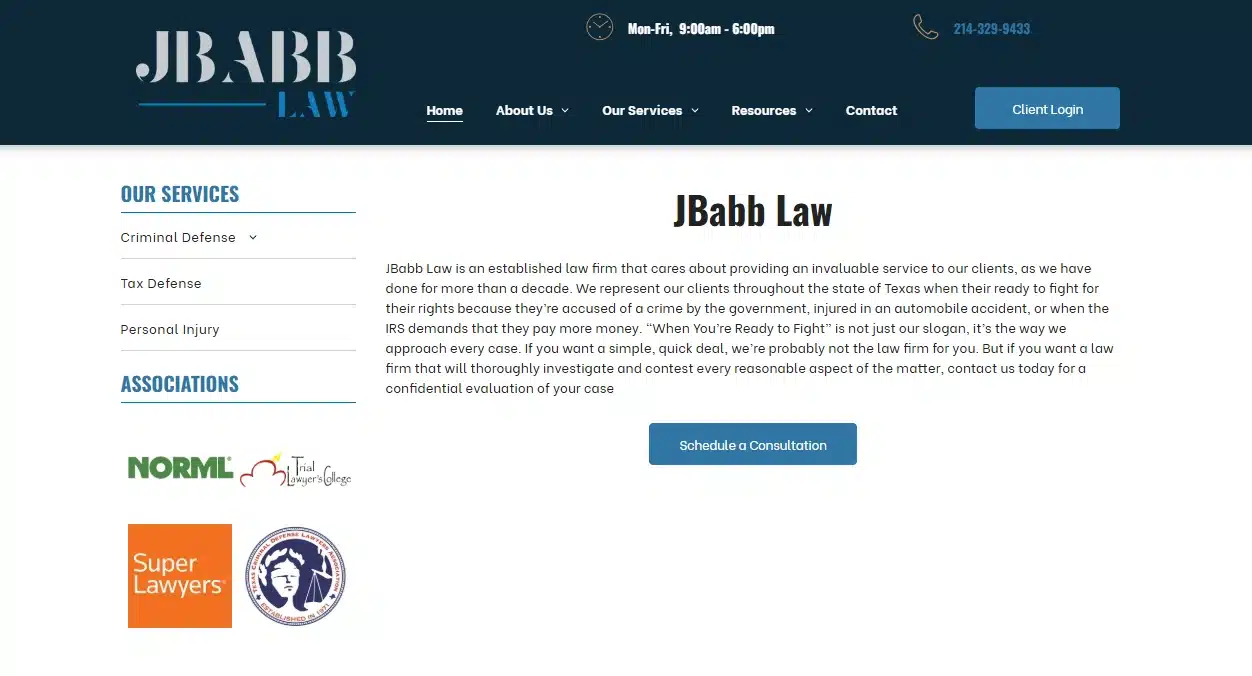
JBabb Law is a criminal defense practice based in Richardson, Texas, serving seven North Texas counties across the Dallas–Fort Worth metroplex. Focusing strictly on DWI/DUI and domestic violence defense, they engaged us for Google Ads management on a $5,000/month budget.
By resisting the temptation to bleed ad spend into broader criminal defense keywords or unserved counties, we maintained extreme campaign precision: delivering high-intent, usable leads (~15/month) while transparently preserving and reporting the client's unspent budget every month.
A market has a ceiling. A budget doesn't raise it.
Two practice areas across seven counties generates a fixed number of relevant searches each month, and no amount of money creates more of them. Once an account is capturing the searches that exist, additional budget can only go one of two places: broader keywords, or a wider geography. Both produce traffic the firm cannot use, and both make the reporting look busier.
The volume is available. It just isn't yours.
Broaden to general criminal defence terms or open the targeting beyond the served counties, and the money goes out of the door. Clicks rise, the monthly report improves, and the firm receives enquiries about matters it doesn't take in places it doesn't practise.
- Budget spent In full
- Clicks Up
- Relevance Down
- Usable enquiries Unchanged
Take the searches that exist and stop.
Cover the relevant terms in the relevant counties thoroughly, then leave the rest of the budget unspent and explain why. It makes for a smaller invoice and a shorter report, and it's the honest answer when demand is the binding constraint rather than money.
- Budget spent Partially
- Clicks Capped by demand
- Relevance High
- Usable enquiries All of them
A narrow practice in a contested metro.
JBabb Law defends DWI and domestic violence charges across Dallas, Tarrant, Collin, Denton, Ellis, Rockwall and Parker counties: the Dallas–Fort Worth area and its surrounds.
Good budget, clear practice areas, and three constraints the budget couldn't solve.
-
Narrow practice, narrow geography
Two charge types in seven counties is a small pool of monthly searches. It's the right way to define a practice and it puts a hard ceiling on how much advertising the market can absorb.
-
Statewide firms outbidding on the same terms
Large Texas firms advertising across the whole state compete for the same DFW searches with far larger budgets. A regional practice cannot win a bidding contest against them and shouldn't try.
-
Intake ran 9 to 5
A significant share of domestic violence enquiries arrived in the evening and overnight. The firm's intake was available during business hours, which meant the most time-sensitive enquiries waited longest.
-
Low volume means slow learning
Fifteen leads a month is a genuine business result and a very small dataset. Everything the account learns takes months rather than weeks, which rules out aggressive testing.
Four decisions for a capped market.
When you can't buy more volume, precision is the only lever left.
Use the words Texas uses
In Texas the adult offence is DWI; DUI generally applies to minors. The distinction matters in the ads and on the pages: a firm advertising the wrong term is either reaching defendants it doesn't want or missing the ones it does.
Ads matching how Texans describe the charge.
Hold the seven counties and don't drift
Targeting bound to the counties the firm actually practises in, resisting the pull to widen when spend fell short. A statewide campaign would have spent the budget and delivered enquiries about courts the firm doesn't appear in.
Every enquiry within reach of the practice.
Compete on specificity, not budget
Against firms advertising across the whole state, the advantage is being unmistakably local to a particular county and court. Ad copy and landing pages built around that rather than trying to outbid a statewide budget.
Winning the searches that mention where they are.
Report the underspend rather than hide it
Every month we reported what the market supported and left the remainder unspent. The alternative is to broaden until the budget clears, which converts an honest ceiling into a busy report and an unusable pipeline.
Around 15 leads a month, all of them servable.
The enquiries arrived at night. The firm opened at nine.
Domestic violence enquiries do not arrive during office hours. They arrive in the evening and overnight, in the hours after something has happened, and this firm's intake ran nine to five.
In a market producing around fifteen leads a month, every enquiry that goes cold overnight is a meaningful share of the month. This wasn't a marketing problem and it wasn't within our scope, but it was the single largest limit on what the advertising could produce.
We raised it in reporting. It remained the case. We're publishing it because leaving it out would make the lead figures look like the ceiling of what was possible, and they weren't: they were the ceiling of what a nine-to-five intake could convert from a market that generates demand at midnight.
For what the alternative looks like, see the after-hours capture and automated booking we built for another criminal defence firm. Same problem, solved rather than flagged.
And the part about the unspent budget
Underspending a client's budget is an uncomfortable thing for an agency to do, particularly one paid on managed spend. It produces a smaller invoice and a report with less in it, and it invites the reasonable question of what exactly is being managed.
But a market that generates a fixed number of searches cannot absorb an arbitrary budget. The money has to go somewhere, and in a narrow practice the only places left are the wrong charges and the wrong counties. Spending it would have been easy, and every extra dollar would have bought an enquiry the firm couldn't take.
Four things for narrow markets.
Check whether demand or budget is the constraint
If your account regularly underspends, that's information rather than a failure. Raising the budget won't help; it will only widen the targeting.
Be suspicious of a budget that always clears
In a narrow market, full spend every month usually means the targeting has been widened to absorb it. Ask where the extra clicks came from.
Beat statewide competitors on specificity
You won't outbid a firm advertising everywhere. You can be unmistakably the local option for a particular county, which is what the searcher is usually looking for.
Match intake hours to when demand arrives
If your enquiries come at night and your phones are answered at nine, your advertising ceiling is set by your opening hours rather than by your budget.
What went into it.
Four of our services, over about a year.
Does your budget clear every single month?
In a narrow practice or a tight geography, that's worth questioning rather than celebrating. Give us read-only access and we'll show you whether the spend is going to searches you can serve, or to the ones that were available. Findings are yours to keep either way.
Read-only access · No obligation · You keep your accounts