
Case studies / Ecommerce
Pool & spa supplies · Ecommerce
The boom ended. The infrastructure didn’t.
A full build: the store designed and developed from scratch, the sales and marketing operations that run it, and a 19,000-SKU catalogue fed by a product data pipeline instead of a buying department. Revenue went from $70,000 to $950,000 in two years, then gave back 37% when the pandemic demand went away and the competition came back, landing at 8.6 times where it started rather than back at the beginning. We’ve run it since 2019, and the work now is making the operation cheaper to run.
Disclosure: DiscoverMyBusiness holds a partial ownership interest in this store. We built it, we market it, and we have a financial stake in it. Treat the figures below with that in mind: they’re reported by a party that benefits from them.
The boom ended. The infrastructure didn’t.
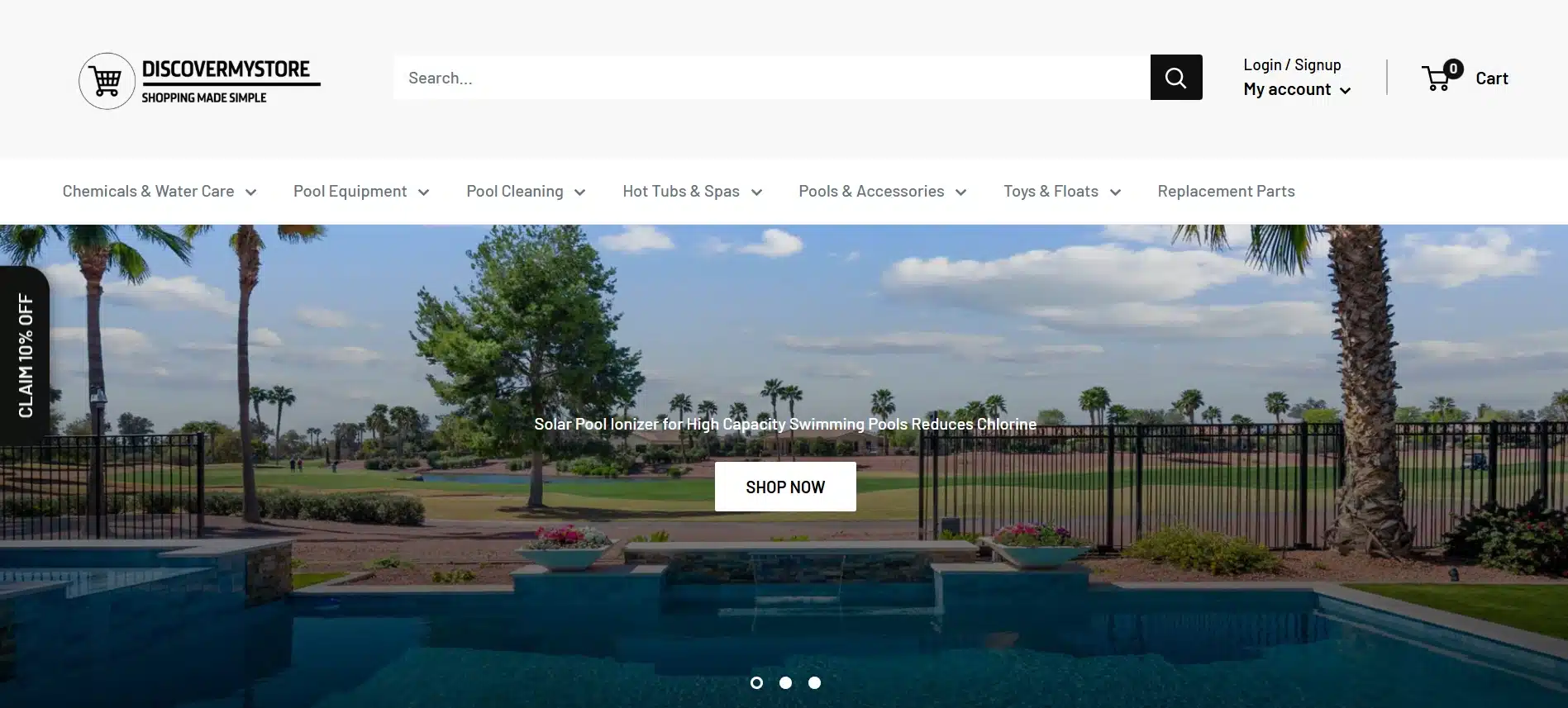
DiscoverMyStore is an eCommerce pool and spa supply brand operated with partial ownership by DiscoverMyBusiness, managing a massive 19,000-SKU catalog powered by direct Amazon Product Advertising API pipelines. Since launching the custom build and multi-channel marketing operations in 2019, revenue grew from a $70,000 baseline to a $950,000 peak (13.6× growth). When post-lockdown demand normalized, the robust data infrastructure, marketplace dominance, and lifecycle flows retained an 8.6× revenue baseline ($600,000) while transitioning toward operational efficiency and AI automation.
A catalogue business is a data problem wearing a storefront.
Nineteen thousand products is not a merchandising job. No buyer writes nineteen thousand descriptions, and nobody checks nineteen thousand prices by hand. The question stops being which products to sell and becomes how product information gets in, how often it refreshes, and what happens when it goes stale, which it does, constantly, because the inventory belongs to someone else.
That scale reaches everything around it. The storefront has to be designed so pages generate rather than get authored. The sales operation has to absorb a season that arrives all at once. The marketing has to work across an owned site and a marketplace at the same time. None of those are campaigns: they’re systems, and they’re what was actually bought here.
What the boom was paying for.
Everyone was home, everyone had a pool or wanted one, and most of the competition had shut down or run out of stock. Demand arrived faster than anyone could merchandise for it, and a catalogue that could list anything was worth more than a catalogue that was carefully chosen.
- Combined revenue$950,000
- In-season traffic~100k/week
- CompetitionThin
- ConstraintSupply, not demand
What was left when it stopped.
Lockdowns ended, discretionary spending moved to travel, and every competitor that had gone quiet came back with stock. Revenue fell 37%. What didn’t fall was the pipeline, the catalogue or the ranking, so the store landed at more than eight times its starting revenue rather than back where it began.
- Combined revenue$600,000
- Change from peak−37%
- CompetitionBack in full
- vs. baselineStill 8.6×
The boom was rented. The infrastructure was bought. Only one of those was still there in year three.
A $70,000 store and a category that only exists for four months.
Pool and spa supplies is a brutal category to build in. The products are heavy, low-margin and dominated by a handful of manufacturers. Demand collapses to nearly nothing for half the year and then arrives all at once. And the customer can almost always buy the identical item somewhere larger.
Four problems had to be solved before any marketing was worth doing.
-
Nineteen thousand products nobody could maintain by hand
Chemicals, pumps, filters, heaters, cleaners, covers, parts. Prices and availability change constantly and none of it is under the store’s control.
-
The customer can reach the same product directly
If someone can buy the identical pump from a marketplace in two clicks, a storefront has to earn its place with something other than access to the item.
-
The season does not wait
Roughly 100,000 sessions a week arrive in-season and almost nothing arrives out of it. Anything broken in May is broken for the year.
-
Stale data is worse than no data
A listed price that’s wrong, or an in-stock badge on something unavailable, costs more trust than the sale was worth. At this catalogue size that risk is permanent.
Eight workstreams, since 2019.
A store built from nothing, the operations to run it, and just over $100,000 of build, about $5 per SKU brought online.
Design and develop the store from scratch
Full custom design and development, not a theme with the colours changed. Brand and visual identity, UI and UX, and an information architecture built to absorb a nineteen-thousand-product catalogue rather than a hand-curated one: category and subcategory structure, templates that generate rather than get authored, faceted navigation and search, and product pages that work when the data behind them is machine-fed.
Then the build itself: responsive front end, checkout and payment paths, performance work for a catalogue this size, and analytics and conversion tracking wired in from the start rather than retrofitted. Nineteen thousand products arranged badly is nineteen thousand products nobody finds.
A store that could grow tenfold without being redesigned.
Build the product data pipeline on Amazon’s official API
Product information comes through the Amazon Product Advertising API rather than off retail pages: the sanctioned route, and the only one that survives contact with Amazon’s terms. It also imposes a real constraint: prices retrieved through it can’t be displayed more than 24 hours later. At 19,000 SKUs that turns refresh into an engineering problem about which products get re-read and how often, not a cron job you set once.
A catalogue that could stay current without a buying department.
Publish 12,000 SKUs to the Amazon affiliate programme
Where the economics favoured it, products route to Amazon under the Associates programme, earning commission at Amazon’s published category rates of roughly 1–5%. That buys catalogue breadth without carrying stock on items that would never justify holding it.
Breadth without inventory risk on two thirds of the catalogue.
Stand up the marketplace side and the infrastructure under it
An Amazon storefront alongside the owned site, with the hosting, data and automation layers running on AWS so the pipeline, the store and the marketplace feeds all draw from the same source rather than three teams maintaining three versions of the truth.
One catalogue, several places to buy from it.
Work the marketplace listings as their own channel
Amazon SEO and Amazon PPC run on different rules to Google: the listing is the landing page, the search terms behave differently, and the ranking factors are sales velocity and conversion rather than links. Treated as a separate discipline, not an afterthought on the ecommerce plan.
Marketplace demand captured rather than conceded.
Build the sales operation behind the storefront
A store is the part customers see; the operation is what decides whether the order arrives. Orders landing from the owned site and the marketplace had to flow through one process rather than two, with order management, fulfilment handoff, customer service and returns running off the same view of the catalogue the storefront uses.
The seasonality is what makes this hard. Support and order volume arrive in a four-month window and almost vanish outside it, so the operation has to absorb a tenfold swing without hiring for the peak and carrying it through the winter. Heavy, low-margin goods make returns expensive enough that handling them badly erases the margin on several sales.
An operation that could take the season without breaking.
Run marketing operations as a system, not campaigns
Paid acquisition and conversion work across the owned store, plus the lifecycle layer underneath it: email and SMS flows doing the work the season can’t (pre-season reactivation, reorder timing on consumables like chemicals and test kits, abandoned-cart recovery), with the reporting to tell which channel actually produced which order across site and marketplace.
In a category with a four-month window, owned audience is the only asset that compounds through the quiet half of the year. Everything else has to be re-bought every spring.
Revenue from people who already bought once.
Now: AI agents against operating cost
The current phase, and the one that follows directly from year three. With the market smaller and the competition back, the useful move is not chasing volume that isn’t there: it’s lowering what the operation costs to run. AI agents handling support and routine catalogue operations are where that work is going.
Ongoing.
What a six-figure build actually contains.
“Marketing agency” undersells what this was. The store did not exist in a form that could carry a catalogue this size, and neither did the operation behind it. Both had to be built before any of the marketing was worth running.
Four pillars, each a project in its own right.
-
Design & development
Brand and visual identity, UI and UX, information architecture for a 19,000-product catalogue, templated product and category pages, faceted search and navigation, responsive build, checkout and payment paths, performance work, and analytics and conversion tracking.
-
Catalogue & data infrastructure
The Amazon Product Advertising API pipeline, refresh scheduling under a 24-hour price-display limit, the AWS layer the data and automation run on, and the affiliate publishing of 12,000 SKUs.
-
Sales operations
Order management across the owned store and the marketplace, fulfilment handoff, customer service, and returns, all built to absorb a season that arrives in four months and then stops.
-
Marketing operations
Ecommerce PPC and CRO on the owned site, Amazon SEO and Amazon PPC on the marketplace, email and SMS lifecycle flows, and cross-channel reporting. Now extending into AI agents against operating cost.
The first three years
Including the year it went down.
These are combined figures (the store’s own sales and Amazon affiliate commission added together) against the $70,000 the store was doing before any of this was built. They cover the first three years of a relationship that started in 2019 and is still running. We’re not publishing the years after that, so the last line below is not a current number.
- Baseline$70,000
- Year one$350,000 · 5.0×
- Year two$950,000 · 13.6× baseline
- Year three$600,000 · −37% from peak
Most agencies would publish the first two lines. The third is the one that makes the first two worth reading.
A large share of year two was the pandemic, not us. Everyone was at home, and most of the competition was shut or out of stock. When that reversed, $350,000 of annual revenue went with it, and no amount of optimisation was going to hold it.
What’s worth arguing about is the floor, not the peak. The store did not return to $70,000. It settled at $600,000, roughly 8.6 times where it started, because the catalogue, the pipeline, the marketplace presence and the email list were all still there when the demand left. Those were bought once and kept working in a worse market.
Against $1.9 million of combined revenue across those first three years, the build cost just over $100,000, or about 5.3%. We’re publishing that because the scale of this project is the main thing a prospective client needs to understand about it, and because a number is more honest than calling it “significant investment.”
What year three actually asks of you
The instinct when revenue falls 37% is to spend into it: more ads, more channels, win the volume back. In a category where the demand itself contracted and the competitors returned, that mostly buys you the same revenue at a worse cost.
The alternative is to accept the smaller market and get cheaper to serve it, which is why the current work is AI agents against support and catalogue operations rather than another acquisition channel. A business that costs less to run is worth more at $600,000 than it was at $950,000 with a full-cost operation behind it.
That decision is why this is still a working relationship in its seventh year rather than a three-year case study with a sad ending. The store was built to survive its own best year, and then had to.
Four things about building on someone else’s catalogue.
Use the sanctioned data route, always
Official APIs come with limits that are irritating to engineer around. Scraping comes with account termination and a business that can disappear overnight. The constraint is the cheaper problem.
Refresh strategy is the whole product
At catalogue scale you cannot refresh everything constantly. Deciding what goes stale and how visibly is a product decision, not an infrastructure detail.
Know which part of your growth you rented
Some of every boom is the market, not the work. Knowing the split before it reverses is what lets you plan for the floor instead of being surprised by it.
In a shrinking market, cost is the lever
When demand contracts and competitors return, buying the volume back costs more than it returns. Lowering what the operation costs to run is the move that survives.
What went into it.
Eight of our services, running since 2019.
Got a catalogue bigger than your team?
If your product data arrives faster than anyone can maintain it, or your revenue has come off a peak and you’re deciding whether to spend into it or get cheaper, those are both problems we’ve run at this scale with our own money on the line. Tell us where the catalogue comes from and we’ll tell you what we’d build.
No obligation · You keep your accounts