
Case studies / Retail
Local inventory feeds · Multi-location retailWe slowed the product feed down on purpose.
Jetson TV & Appliance had a supplier feed refreshing every hour and a national catalogue they couldn't win. We cut the refresh rate, rebuilt the feeds around what was physically in each store, and restricted the whole programme to 25–50 miles. That's where an independent retailer actually beats big box.
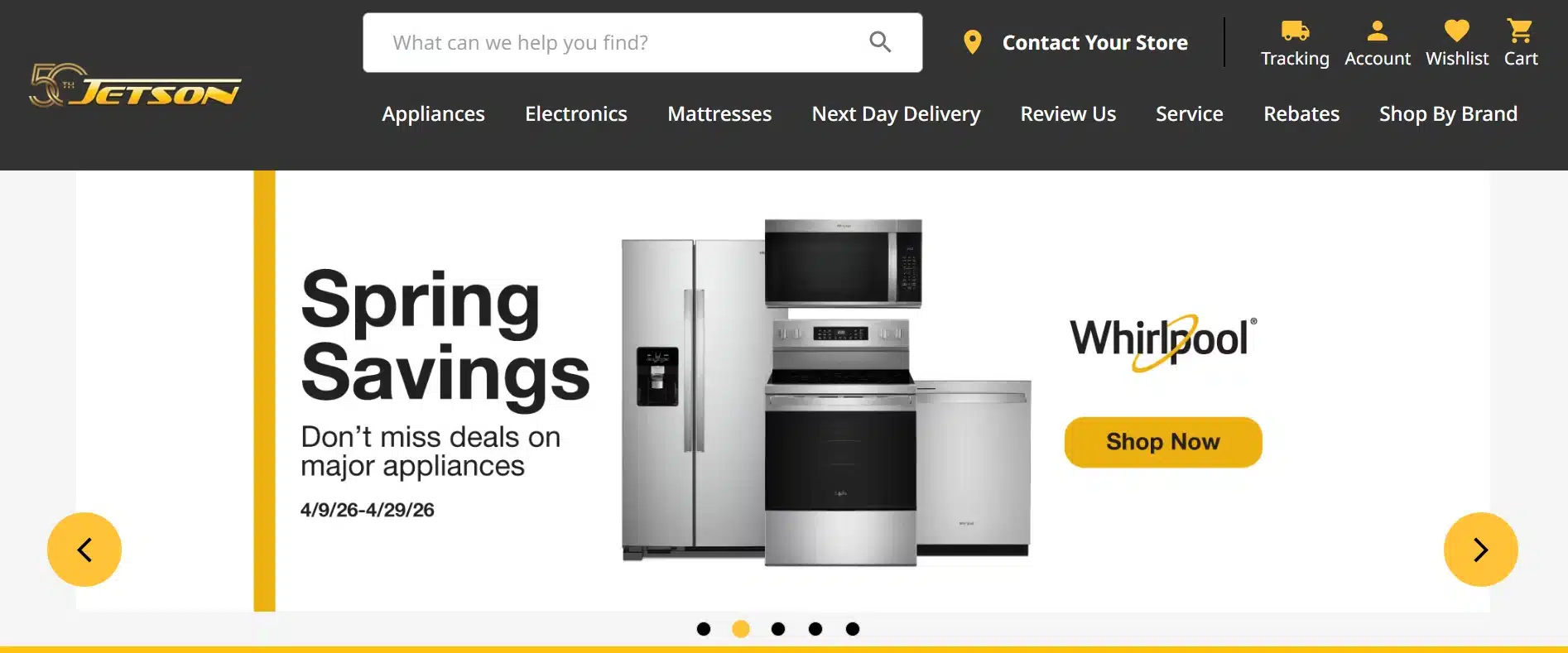
A five-store appliance retailer with a fifty-year head start.
Jetson TV & Appliance has served Florida's Treasure Coast since 1974, operating five stores across Stuart, Port St. Lucie, St. Lucie West, Fort Pierce and Vero Beach.
The offline business was strong, built on decades of local trust. The online side, though, was configured as though it were a national retailer, competing on a supplier catalogue rather than what was actually in stock.
You can't beat Home Depot on price. You can beat them on Friday.
When a refrigerator dies, nobody comparison shops. They ask who can get one into the kitchen soonest. National retailers quote delivery windows measured in weeks. A local retailer with the unit sitting on a warehouse floor twenty miles away can do it tomorrow, but only if the ad tells the buyer it's there.
Competing on someone else's terms.
A feed auto-populated from US suppliers lists thousands of products the store doesn't hold, at prices set by the same distributors everyone else uses. That's a price fight against national retailers with better buying power, and it's a fight an independent loses every time.
- Catalogue Supplier-wide
- Advantage None
- Feed refresh Hourly
- Suspension exposure High
Competing on what's actually in the building.
Feeds built per store from real stock, with in-store availability shown in the ad itself. The buyer sees the model is available nearby, can collect it today or take same-day delivery, and the price fight becomes irrelevant.
- Catalogue What's on the floor
- Advantage Proximity & speed
- Feed refresh 24–72 hours
- Suspension exposure Managed
A trusted local retailer with a national feed problem.
Jetson TV & Appliance has served Florida's Treasure Coast since 1974, operating five stores across Stuart, Port St. Lucie, St. Lucie West, Fort Pierce and Vero Beach. The offline business was strong. The online side was configured as though it were a national retailer.
Four problems, and the first was quietly dangerous.
-
An hourly supplier feed is a suspension risk
The product feed was auto-populating from US suppliers every hour. Prices and availability shifted constantly, which means the feed and the landing page were routinely out of sync, and price or availability mismatch is among the most common triggers for a Merchant Center misrepresentation suspension.
-
The catalogue was fighting the wrong fight
Listing a supplier's full national range means competing on price against retailers with far greater buying power, on products that weren't in any of the five stores. There was no advantage to be had in that auction.
-
Nothing told the buyer the item was nearby
The single most persuasive fact, that the appliance is twenty minutes away and can be delivered tomorrow, appeared nowhere in the advertising.
-
No way to promote local offers
Seasonal promotions on full kitchen packages and appliance bundles are how this business actually sells. None of that existed in the feed structure.
Five steps, starting by slowing things down.
The first decision looks like a step backwards and was the one that protected everything after it.
Cut the feed refresh from hourly to 24–72 hours
Counterintuitive, and deliberate. An hourly supplier sync means the price Google crawls on the landing page is frequently not the price in the feed, and that mismatch is a documented route to a misrepresentation suspension. A slower, stable refresh keeps feed and site aligned, protecting the account that everything else depended on.
Feed and landing pages in agreement. Suspension risk managed.
Build a separate feed for every store
Five custom feeds inside Merchant Center, one per location, populated from the inventory actually held at that store rather than from the national supplier catalogue. Each location advertises what it can hand to a customer.
Five stores, five catalogues, no phantom stock.
Put in-store availability in the ad
Shopping listings configured to show availability at the nearby store, so the badge does the selling before anyone clicks. For someone whose appliance has just failed, "available in store" is a stronger proposition than any discount a national retailer can offer against a two-week delivery window.
The logistics advantage became a search advantage.
Wire promotions into the feeds
Seasonal offers and full kitchen appliance packages built into the feed structure per location, so promotional pricing surfaced in Shopping rather than living only on the website. Search and call campaigns ran alongside, pointed at the sales department.
Over 10% click-through rate across search.
Restrict everything to 25–50 miles
The whole programme was geofenced to the radius each store could genuinely serve with pickup or same-day delivery. Traffic beyond that was excluded rather than optimised, since a buyer three hundred miles away has no reason to choose a Treasure Coast retailer over a national one.
The year's central finding, tested and confirmed.
Online sales only happened inside the delivery radius.
The twelve months had a thesis attached: that for a regional appliance retailer, online revenue only materialises when the advertising is restricted tightly to the area the stores can physically serve.
Twenty-five to fifty miles. Inside that radius the store has stock, pickup and same-day delivery, advantages no national retailer can match. Outside it, there is nothing to offer that Home Depot doesn't offer better and cheaper.
That sounds obvious written down. It runs against how most retail ecommerce is built, which assumes a larger addressable market is always better and treats geographic restriction as leaving money on the table.
For a business whose advantage is physical, the opposite is true. Every dollar spent reaching someone outside the delivery radius is a dollar spent competing with national retailers on price, shipping and range, three fights an independent cannot win.
Why the feed work had to come first
None of this is possible on a national supplier feed. You cannot advertise in-store availability without knowing what each store holds, and you cannot promise same-day delivery on a product that exists only in a distributor's warehouse.
The per-location feeds weren't a technical detail underneath the strategy. They were the strategy, the mechanism that turned a physical advantage into something a search result could express.
Four things for any retailer with physical stock.
Faster feeds are not safer feeds
If your feed updates more often than your site can keep pace with, you're generating price and availability mismatches. That's a documented suspension trigger, and a stable refresh beats a fast one.
Advertise what you hold, not what you can order
A supplier catalogue puts you in a price fight on products you don't have. Your own stock is the only inventory where you have an advantage worth paying to advertise.
Put availability in the ad, not the landing page
For urgent purchases, "in stock nearby" beats a discount. If the buyer has to click to find out whether you have it, most of them won't.
A smaller radius can be the growth strategy
If your advantage is physical, spending outside your service area funds a fight you lose. Narrowing the target isn't giving up reach, it's concentrating budget where you win.
What went into it.
Six of our services, across five store locations.
Advertising products you don't actually have?
If your feed comes from a supplier rather than your own stock, you're competing on price against retailers who buy better than you, and risking a suspension every time the feed and your site disagree. Give us read-only access and we'll show you what's in your feed that isn't in your building. Findings are yours to keep either way.
Read-only access · No obligation · You keep your accounts