
Case studies / Legal
Personal injury · Northern Ohio
We didn’t lower the bids. We changed where the clicks landed.
Ryan LLP was paying $35 to $50 a click for personal injury traffic in northern Ohio and converting it at half a percent. We built four landing pages, one per practice area. Conversion went to 15%, and the clicks got cheaper at the same time. Those two things were the same change.
About the client
We didn’t lower the bids. We changed where the clicks landed.
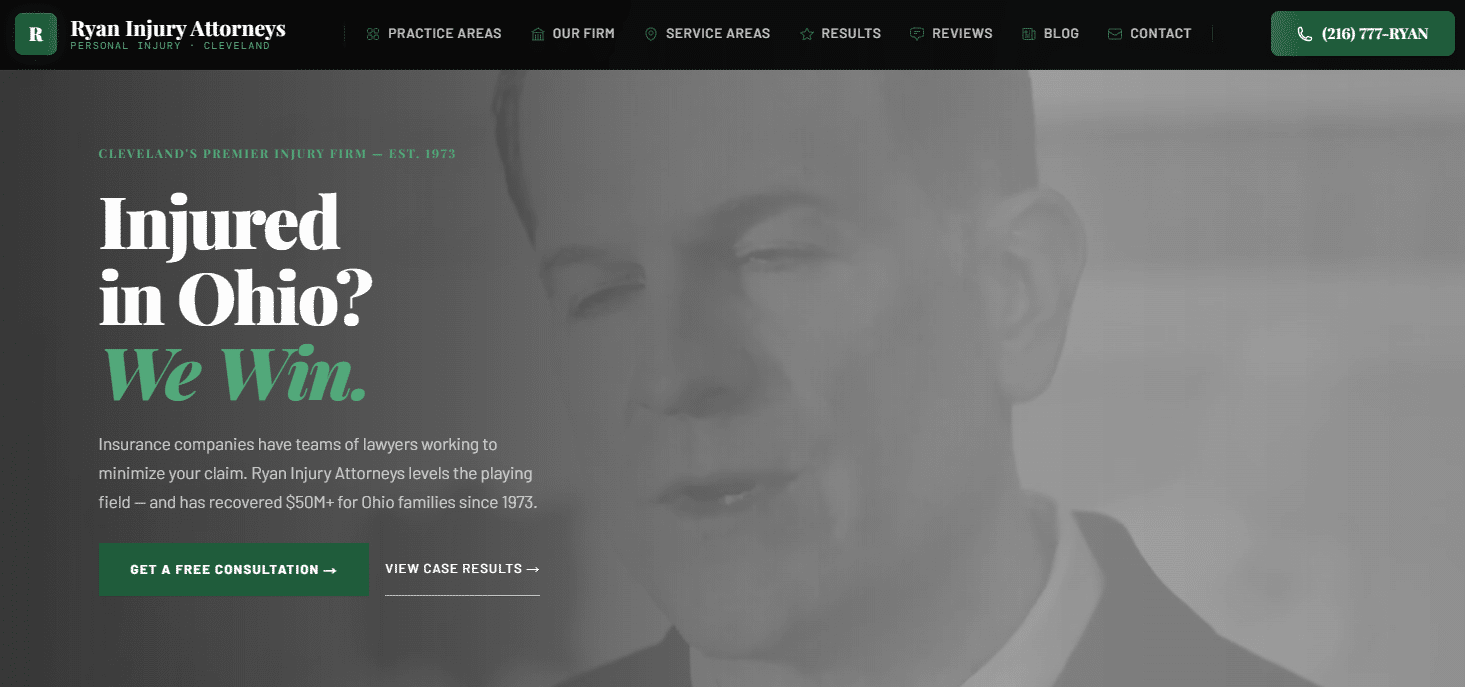
Ryan LLP (Ryan Injury Attorneys) is a Cleveland-based personal injury law firm serving individuals and families across Northern Ohio. They partnered with us for a three-year engagement after spending $35 to $50 per click on broad search campaigns directed to a single generic homepage converting at just 0.5%. We decoupled their traffic by creating four practice-specific landing pages (auto accident, medical malpractice, pedestrian injury, and general injury) and rebuilding the ad structure around them. Aligning tight keyword intent with dedicated destinations dropped average click costs from $35–$50 down to ~$5 while driving landing page conversion rates to ~15% and delivering 71 leads per month.
Conversion and click price are not two problems.
Most firms hire one vendor for the ads and another for the website, which quietly assumes those are separate disciplines. They aren’t. A generic destination forces you to buy expensive, broad keywords, because they’re the only ones a generic page can answer. A specific destination lets you buy specific keywords, which are cheaper, and which convert.
One website, four practice areas, every click.
Someone searching for a medical malpractice attorney lands on a firm homepage that also does auto accidents, premises liability and workers’ comp. They have to find themselves on the page before they can act. Most don’t. And because the page answers nothing specifically, only the broadest and most contested keywords make sense to bid on.
- Keywords it can serveBroad, head terms
- Click price$35–$50
- Message matchApproximate
- Site-wide conversion~0.5%
Four pages, one question answered on each.
Someone searching a specific injury lands on a page about that injury, with the relevant proof and one thing to do next. That page can also answer long-tail searches a homepage never could, which are the cheap ones, because far fewer firms bid on them and the landing page’s relevance is scored higher.
- Keywords it can serveSpecific, long-tail
- Click price~$5
- Message matchExact
- Landing page conversion~15%
One change produced both columns. That’s the whole case study.
The most expensive clicks in legal, sent to a homepage.
Ryan LLP is a personal injury firm in northern Ohio. They were already advertising, and already paying personal injury rates to do it: the clicks were costing $35 to $50 each and arriving at a general-purpose website.
Four things were true when we started.
-
$35–$50 a click, in one of the most contested categories there is
Personal injury is near the top of the paid search market everywhere, and northern Ohio is no exception. At that price every wasted click is a real cost.
-
Every campaign pointed at the same place
Auto accident searches, malpractice searches and general injury searches all arrived at the same general website, which addressed all of them and therefore none of them.
-
Around half a percent of site visitors became an enquiry
That’s the main site’s overall rate before any dedicated page existed. Whatever the precise paid-only figure was, the destination was not doing the work.
-
There was no cheap keyword to move to
This is the part that traps firms. You can’t bid on specific long-tail searches when your only landing page is a homepage, because the homepage won’t convert them. So you stay on the expensive terms.
Four pages, then an account rebuilt around them.
The pages came first. Everything else followed from what they made possible.
Build one landing page per practice area
Auto accident, medical malpractice, pedestrian accident and general personal injury. Each page answers one question, carries the proof relevant to that one claim type, and asks for one thing. Not four sections of a website: four separate destinations.
A page capable of converting a specific search.
Rebuild the campaigns to match the pages, not the firm
Campaign structure mirrored the four pages exactly, so every keyword had a destination written for it. That’s what made the long-tail viable: a search for a specific injury could now go somewhere that answered it, which meant it was worth bidding on at all.
Average cost per click from $35–$50 to roughly $5.
Make relevance do the work bidding used to
When the search, the ad and the landing page say the same thing, Google scores the match higher and charges less for the same position. Tight keyword-to-ad-to-page alignment across four pages is the cheapest form of bid management there is, and it compounds.
Better positions at a fraction of the previous click price.
Keep testing the pages for three years
Form length, proof placement, headline against the ad, mobile layout, what sits above the fold. A landing page is not a deliverable that gets signed off once; it’s the part of the account you can keep improving after the auction stops giving you anything.
Around 15% of landing page visitors becoming leads.
Produce YouTube creative with AI video generation
Later in the engagement we used AI video generation to produce YouTube creative at a volume and cost that conventional production wouldn’t have allowed for a firm this size. We’re listing it because we did it, not because we can attribute leads to it: we hold no performance data isolating its contribution.
Creative volume without a production budget.
212 leads, and what was wrong with 39 of them.
We hold a complete lead record for February to April 2024, near the end of the engagement. It’s three months out of three years and we’re not presenting it as the average. It’s here because it’s the one period where we can count rather than characterise.
- Leads, three months212
- Average per month71
- Spam or disqualified39 (18.4%)
- Usable173 (81.6%)
We can’t show you the records. They list injured people by name alongside what happened to them, and that does not belong on a marketing page in any form (not quoted, not screenshotted, not blurred). What’s publishable is the shape.
The most specific page produced the cleanest leads
Medical malpractice was 38% of all leads in the quarter and had zero disqualifications. Not a low rate: none. Every disqualified or spam lead in the period came from somewhere else in the account.
That is the argument on this page, arriving as evidence rather than theory. Medical malpractice is the narrowest, most self-selecting thing the firm does, and it had the most specific page pointed at it. People who worked out they had a malpractice claim, searched for exactly that, and landed on a page about exactly that, did not need filtering afterwards.
The leads that needed filtering came through broader routes, where the search was vaguer and the page had to be too. Specificity isn’t only cheaper and higher-converting. It also changes who arrives.
The firm was signing between two and five cases a month during the engagement, by their own count. We’re reporting that as they gave it to us and making no claim about any matter beyond the fact that it was signed.
From the firm.
Ryan LLP · five-star review posted publicly on Google.
The line worth noticing is “increase in quality.” Cheaper clicks and higher conversion are our numbers, and they’d be worth little if the firm had simply received more of the wrong thing. The quarter we counted says the same: four out of five leads were usable, and the practice area with the most specific page had no bad ones at all.
Three years, then an in-house team.
The engagement ran three years and ended when Ryan LLP brought marketing in-house. That’s a normal ending for an account that works: once the structure is built and the pages are converting, a firm reaches a size where owning it makes sense.
We’re including this because case studies that never say how anything finished are worth less than ones that do.
What transfers
Four things about where your clicks land.
Your landing page sets your keyword options
If the only destination is a homepage, only broad expensive terms are worth buying. Build the specific page and a cheaper half of the market becomes available that wasn’t before.
Relevance is a discount, not a nicety
Search, ad and page saying the same thing is scored and priced. It is the cheapest lever in paid search and the one most often handed to a separate vendor.
One page per thing you sell
Not one page with four sections. If a visitor has to locate themselves on the page before they can act, you’ve already lost most of them.
Count your bad leads before you celebrate volume
Here it was 18% across the account and 0% on the tightest page. That spread tells you where to spend next, and it only exists if someone is marking leads as they arrive.
What went into it.
Five of our services, over three years.
Where does your paid traffic actually land?
If every campaign points at the same page, you’re paying for the most expensive keywords available and converting a fraction of them. Give us read-only access and we’ll show you which searches you can’t currently afford to buy, and what a page built for them would change. Findings are yours to keep either way.
Read-only access · No obligation · You keep your accounts