
Case studies / eCommerce
Google Shopping & retargeting · Three yearsWe took 3% of revenue instead of a percentage of spend.
Most agencies are paid more when a client spends more. For Leather Stand and Vest we discounted the management fee and took a share of attributed revenue instead, so the only way our income grew was if theirs did. It ran that way for three years.
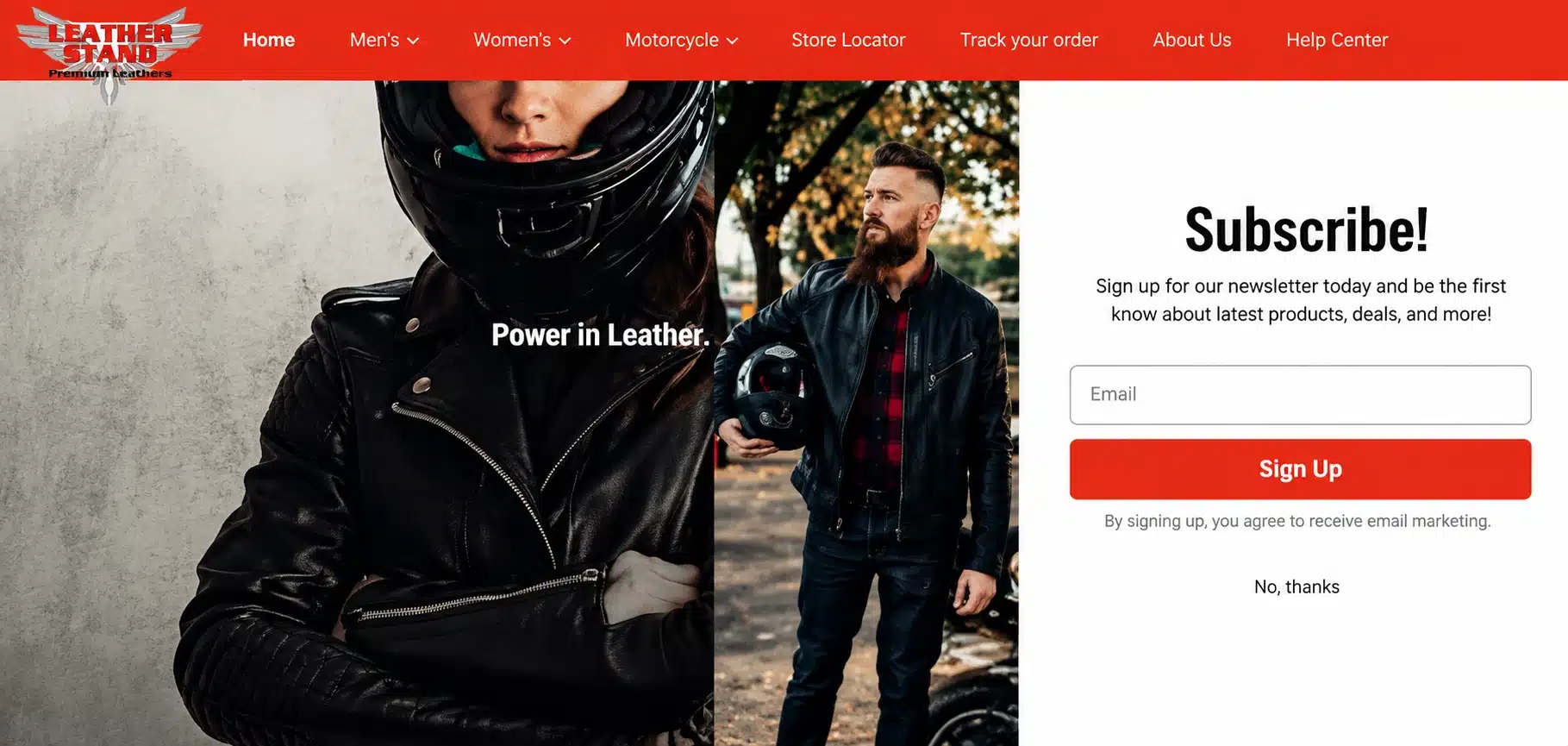
A leather apparel brand with a considered purchase to sell.
Leather Stand and Vest sold leather jackets and vests through a home and store operation, with an established customer base and a category with particular demands on how it gets sold online.
We were brought in to run Google Shopping and AdRoll retargeting for the brand, on a fee model built around revenue rather than media spend.
How an agency is paid decides what it recommends.
The standard agency fee is a percentage of media spend. It's simple, it's normal, and it quietly means that every conversation about budget is a conversation about the agency's own income. Nobody sets out to give self-serving advice, but an incentive that points one way for years doesn't need anyone's intent to have an effect.
Paid more when you spend more.
The agency's income rises with the budget, whether or not the budget is working. Recommending a pause, a cut, or a slower month costs the agency money, so those recommendations get made less often than they should.
- Agency earns more when Spend rises
- Cost of recommending a cut Direct
- Aligned with Media volume
- Pressure Spend more
Paid more when you sell more.
A discounted management fee plus a share of attributed revenue. Spending more doesn't earn us anything unless it produces sales, which makes efficiency our problem as much as the client's, and makes saying "don't spend that" an easy thing to do.
- Agency earns more when Revenue rises
- Cost of recommending a cut None
- Aligned with Sales
- Pressure Sell more
A considered purchase with a fit problem.
Leather Stand and Vest sold leather jackets and vests through a home and store operation. Good product, established customer base, and a category with particular demands on how it gets sold online.
Four things shaped the account.
Nobody buys leather on the first visit
A jacket at this price is researched, compared, and slept on. Sizing, weight of the hide, and fit are all questions a product page has to answer before anyone commits, and most visitors leave to think about it.
Apparel feeds are detail heavy
Size, colour, material, and variant data all have to be right for Shopping to serve the correct product to the correct search. Apparel is one of the least forgiving categories for a loosely built feed.
The budget was modest for the category
Roughly $6,000 a month across both platforms in a category where clothing CPCs are competitive, enough to work with, not enough to waste.
The fee model had to reward the right thing
With a considered purchase and a limited budget, the last thing the account needed was an incentive pointing toward spending more rather than selling more.
Four parts, run for three years.
Built around the gap between a first visit and a purchase.
Merchant Center and the apparel feed
Account setup and a product feed built to apparel requirements: size, colour, material, and variant data structured so the right product could be matched to the right search rather than the catalogue competing with itself.
A catalogue eligible and correctly matched.
Shopping as the acquisition channel
Google Shopping carrying the discovery load, with product grouping set up so performance could be read by product type rather than as one blended figure across jackets and vests.
The channel that produced most of the revenue.
AdRoll retargeting to close the gap
Retargeting across the web through AdRoll, because in this category the first visit is research and the purchase happens days later. Staying visible during that gap is the difference between a sale and a browser who forgets the brand name.
Revenue from visitors who had already left once.
Attribute revenue properly, because we were paid on it
Revenue tracked and reported per platform every month. When the fee is a share of attributed revenue, the measurement has to be accurate in both directions: the client sees exactly what each channel produced, and so do we.
Reporting both sides had reason to trust.
What the invoice actually showed.
Fee invoices on this account listed the revenue they were calculated from, so every month both sides saw the same numbers. One November looked like this:
- Google Ads attributed revenue $32,246.95
- AdRoll attributed revenue $3,146.48
- Total attributed revenue $35,393.43
- Our 3% fee $1,061.80
Against an average media budget of around $6,000 a month across both platforms, that month returned roughly six times what was spent. Spend varied month to month, so treat the multiple as indicative rather than exact.
Note what the fee doesn't reward. We earned nothing extra for raising the budget, only for the revenue it produced. A month where we recommended spending less and sold the same amount paid us exactly the same.
Why we don't offer this to everyone
Revenue share works when attribution is clean, the product sells online, and the client is comfortable sharing their numbers monthly. Remove any of those and it becomes an argument rather than an arrangement.
It also isn't automatically cheaper. In a strong month the client pays us more than a flat fee would have cost them, which is the point, and worth understanding before anyone agrees to it.
But where it fits, it removes an awkward conversation permanently. Nobody has to wonder whether the budget recommendation is about their business or ours.
Three months in.
"One of the most professional company I have ever worked with. I have been working with DiscoverMyBusiness for the last three months, and the results are overwhelming."
Waqar Khan · posted publicly on Google, three months into the engagement. It ran for another two and a half years after that.
Four things worth taking from this.
Ask how your agency is paid
If the fee is a percentage of spend, budget advice carries a built in direction. That doesn't make it wrong, it makes it worth knowing when you hear it.
Considered purchases live in retargeting
When the decision takes days, staying visible through the gap matters more than reaching more people once. Budget for the return visit.
Apparel feeds punish shortcuts
Size, colour, material, and variant structure decide whether Shopping matches the right product to the right search, or whether your own listings compete with each other.
Revenue share needs clean attribution
It only works when both sides agree on what counts. Settle the measurement before the percentage, or the arrangement becomes a monthly dispute.
What went into it.
Five of our services, over three years.
Is your agency paid to spend, or paid to sell?
Worth knowing before the next budget conversation. Give us read only access and we'll show you what your accounts are actually producing, and tell you honestly whether spending more is the right recommendation. Findings are yours to keep either way.
Read only access · No obligation · You keep your accounts