
ShipBob: Pricing, Features & Fulfillment Solutions for Growing Ecommerce Brands
TL;DR:
- What it is: ShipBob is a global ecommerce fulfillment provider (3PL). It stores your inventory, then picks, packs, and ships your orders from 50+ fulfillment centers.
- What it does: ShipBob combines a distributed warehouse network, 2-day shipping across the continental US, free fulfillment software, and 50+ integrations. As a result, online brands can cut shipping costs, speed up delivery, and scale without running a warehouse.
- What it costs: Pricing is quote-based and customized to your business. However, standard fees cover implementation, receiving, storage, and picking, packing, and shipping each order. Also, ShipBob’s software is free for all customers.
- Who it’s for: Direct-to-consumer brands, Shopify and marketplace sellers, and growing B2B and omnichannel merchants. They all want to outsource fulfillment.
ShipBob is a global ecommerce fulfillment platform that helps online businesses simplify order fulfillment, reduce shipping costs, and scale without managing their own warehouses. From inventory storage and pick-and-pack services to international shipping, returns, and 2-day delivery across the continental US, ShipBob combines a global fulfillment network with technology that keeps orders moving efficiently. With support for 200+ retail channels, inventory distribution tools, and AI-powered capabilities, it helps growing ecommerce brands streamline operations and focus on growth. Businesses can also pair reliable fulfillment with ecommerce optimization services to improve the shopping experience and convert more customers.

What Is ShipBob and What Does It Do?
ShipBob is an end-to-end ecommerce fulfillment provider for businesses to manage inventory storage, order fulfillment, shipping, and returns without building and operating their own warehouse teams. It serves direct-to-consumer (DTC) brands, Shopify merchants, marketplace sellers, and businesses supplying retail partners, providing a streamlined way to handle logistics, meet customer expectations, and scale ecommerce operations.
Here’s what ShipBob does:
- Stores your inventory: Products are first received, then warehoused across a network of 50+ fulfillment centers worldwide
- Picks, packs, and ships orders: Orders are fulfilled from the center nearest your customer, so transit time and cost drop
- Distributes inventory by region: The Inventory Placement Program lets you send stock to one hub, then places it across US regions with automated replenishment
- Offers 2-day shipping: Delivery takes 2 days across the continental US, so merchants can promise it on all sales channels
- Creates branded unboxing experiences: You can use custom boxes, mailers, and inserts, although you pay to store them
- Ships internationally: Orders can go to 250+ destinations, while standard and expedited options include DDP
- Fulfills B2B and wholesale orders: Automated EDI-compliant orders and larger wholesale shipments are supported for an additional cost
- Connects to your tools: 50+ integrations cover ecommerce platforms, marketplaces, ERPs, and returns tools, and a developer API is also available
In short, ShipBob gives online brands a single partner for storing, shipping, and tracking inventory. It replaces the patchwork of in-house packing, multiple warehouses, and separate shipping tools.
How ShipBob Helps Your Business: Faster Delivery and Lower Shipping Costs
Whether you ship a few hundred orders a month or scale toward nine figures, ShipBob aims to make fulfillment more predictable. Its network, carrier relationships, and software also shorten delivery times. At the same time, they keep total fulfillment costs under control.
ShipBob for growing DTC brands: scale without hiring a warehouse team
Brands can hand off picking, packing, and shipping. As a result, their own team stays focused on product and marketing. For example, Bloom Nutrition’s operations lead says the company scaled to nine figures in sales and runs its operations with a three-person team. However, these are customer-reported results, and outcomes vary by brand and order volume.
ShipBob for cost-conscious merchants: shared carrier discounts
ShipBob says its overall order volume lets it negotiate bulk rates with carriers such as UPS, USPS, FedEx, and DHL. It then passes those savings on to merchants. For instance, Spikeball’s warehousing director reports total fulfillment cost savings of 40% after switching. Similarly, Our Place reports $1.5 million in freight savings after expanding from 2 to 4 warehouses. Stores that want lower fulfillment costs and higher conversion can also look at Shopify web design for the storefront side.
ShipBob for marketplace and omnichannel sellers: one network, many channels
ShipBob supports 200+ retail channels. It also connects to platforms such as Shopify, BigCommerce, NetSuite, Walmart, and Amazon. As a result, brands can fulfill orders from a single inventory pool, whether the sale comes from their own site or a marketplace. Brands that sell on Amazon or Walmart can use online marketplace marketing services to drive more of those orders.
ShipBob for international expansion: one partner across regions
Because ShipBob has fulfillment centers in the USA, Canada, the UK, Australia, and Europe, merchants can expand into new markets from one dashboard. Instead of signing separate agreements in each country, they work with one partner.
ShipBob Features: Tools to Store, Ship, and Scale
Overall, ShipBob’s feature set covers the full journey, from inventory arriving at the warehouse to the customer opening the box.
- Fulfillment Network of 50+ Centers: Store inventory close to customers, so orders arrive sooner across the US and internationally
- Inventory Placement Program: Send inventory to one hub, then distribute it across US regions with automated replenishment
- 2-Day Shipping: Offer 2-day delivery across the continental US, because it applies to all sales channels
- Order Fulfillment: ShipBob teams handle picking, packing, shipping, and returns, so you do not have to
- Real-Time Inventory Tracking: See stock across warehouses, and set reorder alerts so you never run short
- International and Global Fulfillment: Ship to 250+ destinations while fulfilling from centers across several regions
- Customized Unboxing: Use your own branded boxes, mailers, and inserts
- Standard Packaging Included: Otherwise, plain brown boxes, poly mailers, bubble mailers, tape, dunnage, and labels are used for orders
- Kitting: Approved merchants can then have items assembled into kits and bundles
- Returns Management: Flat-fee returns processing, while discounted label buying is optional
- B2B and EDI Fulfillment: Support for retailer orders and wholesale, as well as labeling, pallet preparation, and freight quotes
- Free Fulfillment Software: Use the ShipBob dashboard to manage inventory, orders, and shipments, because software costs nothing extra
- 50+ Turnkey Integrations: Connect Shopify, BigCommerce, NetSuite, Gorgias, Klaviyo, AfterShip, Loop Returns, Amazon, and more
- Developer API: Build custom connections directly with ShipBob’s API
- ShipBob WMS: Warehouse management software for merchants who still run their own US-based warehouses
- ShipBob AI, MCP, and Bobby: Use live fulfillment data inside Claude, the ShipBob dashboard, or other AI tools
As a result, brands can run fulfillment as a connected system. Inventory, orders, and customer delivery data then live in one place.
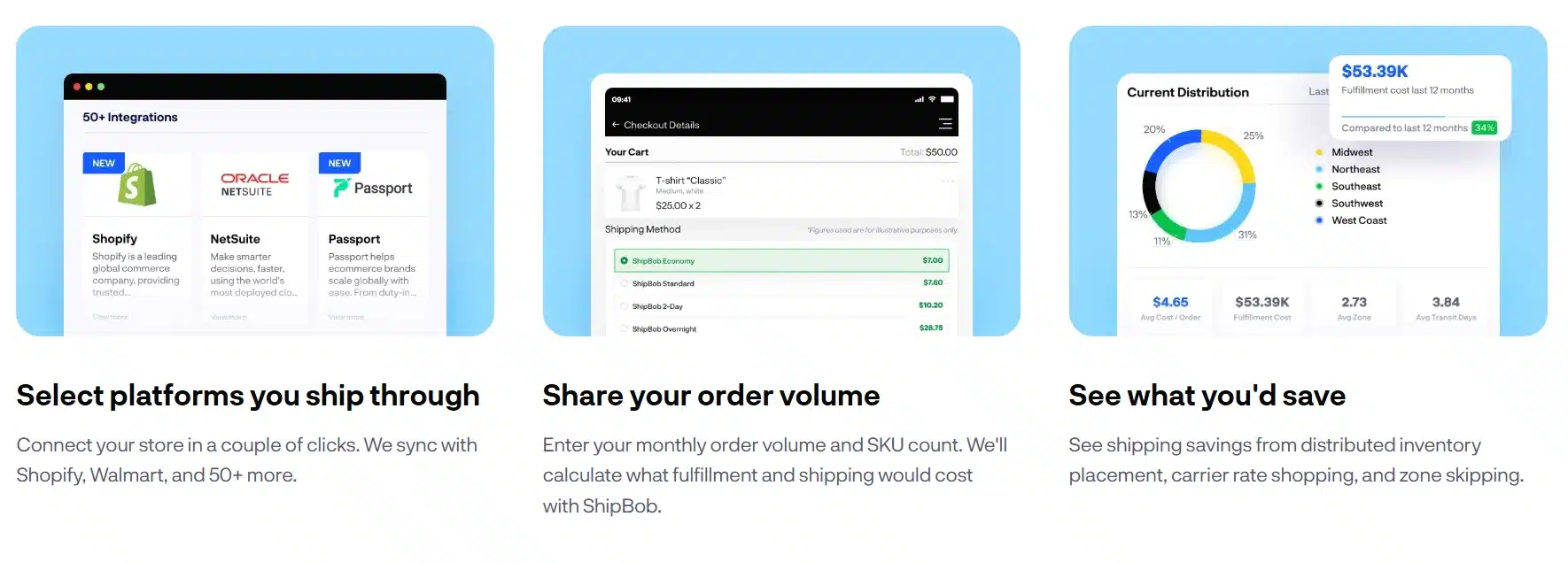
How to Use ShipBob: A Simple Guide to Getting Started
Overall, getting started with ShipBob follows a short, repeatable path from quote to first shipment.
- Request a quote from ShipBob: Fill out the form so a fulfillment expert can review your order volume, products, and needs
- Review your customized pricing: Then check the quote for implementation, receiving, storage, and fulfillment fees
- Connect your store: Link your ecommerce platform or marketplace, then sync your products in a few clicks
- Prepare your inventory: Label and box your products before shipping them to ShipBob’s fulfillment centers
- Send inventory to ShipBob: Ship stock to your chosen hub, then let ShipBob help distribute it to match your demand
- Set up packaging and extras: Choose standard packaging or send branded materials, then request kitting or B2B services if needed
- Go live and track orders: ShipBob picks, packs, and ships, while you follow inventory and shipments in the dashboard
- Review and optimize: Use reporting to adjust inventory placement, reorder points, and shipping choices when sales grow
By following these steps, merchants can move from managing shipments themselves to a hands-off fulfillment workflow. Then the process stays clear and structured as sales grow.
ShipBob Pricing: Fulfillment Fees and Additional Services
ShipBob’s pricing plans are quote-based, so there are no fixed plan tiers to compare. In other words, the company describes its fees as a total fulfillment cost for direct-to-consumer orders. Specifically, they come from a small set of standard charges plus optional services. Also, software is free for all customers, including turnkey integrations.
Standard fees in a ShipBob quote
| Fee | What it covers | Notes |
|---|---|---|
| Implementation | Getting your account, integrations, and products set up | Part of standard ShipBob fees |
| Receiving | Checking in inventory when it arrives at a fulfillment center | Part of standard ShipBob fees |
| Warehousing (storage) | Storing your products in the fulfillment center | Part of standard ShipBob fees |
| Pick, pack, and ship | Picking items, packing the order, and shipping it to your customer | Shipping cost varies by weight, dimensions, destination, and service |
Additional services at US fulfillment centers
| Service | What it covers | Pricing |
|---|---|---|
| Standard packaging | Plain brown boxes, poly mailers, bubble mailers, tape, dunnage, and shipping labels | Included for orders |
| Custom branded packaging | Your own boxes, mailers, and inserts | You pay to store them |
| Kitting | Assembling items into kits and bundles | Available once approved, additional cost |
| Returns | Processing all items in a return | Flat fee, charged when the return arrives at the fulfillment center |
| B2B / wholesale / EDI | Labeling, pre-paid labels, pallet preparation, freight quotes, and automated EDI orders | Additional cost |
| Special projects | Extra labor for custom requests | Quoted on request, so confirm the current rate in your quote |
| International shipping | Orders to 250+ destinations, including DDP | Quoted on request |
| WMS (own US warehouse) | ShipBob’s warehouse management software | Separate WMS pricing, available on request |
Request Your ShipBob Pricing Quote →
ShipBob Inventory Placement and 2-Day Shipping: Closer to Your Customers
Why where your inventory sits matters
Shipping cost and delivery time are mostly decided by distance, so inventory location matters. When all your inventory sits in one warehouse, customers on the far side of the country wait longer. You also pay more for each parcel. Therefore, ShipBob’s distributed network is built to fix this by placing products near where customers live.
One hub in, many regions out
With the Inventory Placement Program, high-volume brands send inventory to a single location. ShipBob then distributes it across US regions with automated replenishment. As a result, orders ship from the nearest fulfillment center as soon as a customer checks out.
2-day shipping for the continental US
ShipBob also offers 2-day shipping across the continental US for all sales channels. That gives merchants a delivery promise, so they can show it at checkout and on marketplaces. In fact, many brands use it to lift conversion and average order value.
Placement in action: faster delivery and lower cost per order
For example, Our Place reports that expanding from 2 to 4 warehouses cut its fulfillment and shipping time from 5 or 6 days to about 2.5 days. It also reports $1.5 million in freight savings. Meanwhile, Semaine Health says the Inventory Placement Program reduced its fulfillment costs by more than $2 per order compared with its previous 3PL. However, these are customer-reported results, so your results will depend on your products, order volume, and customer locations.

ShipBob Technology: Dashboard, WMS, Integrations, and AI
Why fulfillment technology is as important as the warehouse
A warehouse is only as useful as the information around it, so technology matters. That is why ShipBob’s fulfillment technology gives merchants a single place to see stock, orders, and shipments. It also connects that data to the tools they already run their business on.
A free dashboard and 50+ integrations
The ShipBob dashboard is free for all customers and includes turnkey integrations. Merchants connect their stores, then manage inventory, orders, shipments, and returns from one login. Specifically, integrations cover platforms such as Shopify, BigCommerce, and NetSuite. They also cover marketplaces such as Amazon and Walmart, and tools such as Klaviyo, Gorgias, AfterShip, and Loop Returns. Additionally, a developer-friendly API is available for custom connections.
ShipBob WMS for brands with their own warehouse
Merchants that still keep a US-based warehouse can use ShipBob’s warehouse management system to run their own operation. However, separate WMS pricing is available on request. As a result, this helps brands that fulfill part of their volume themselves and part through ShipBob.
ShipBob AI in action: fulfillment data you can act on
In addition, ShipBob describes ShipBob AI as an action layer built on its own network and data. Also, with ShipBob MCP and a tool called Bobby, merchants can use live fulfillment data in Claude, the dashboard, or other AI tools. Brands that want to go further across marketing and operations can explore email marketing services that use order and shipping data for post-purchase campaigns.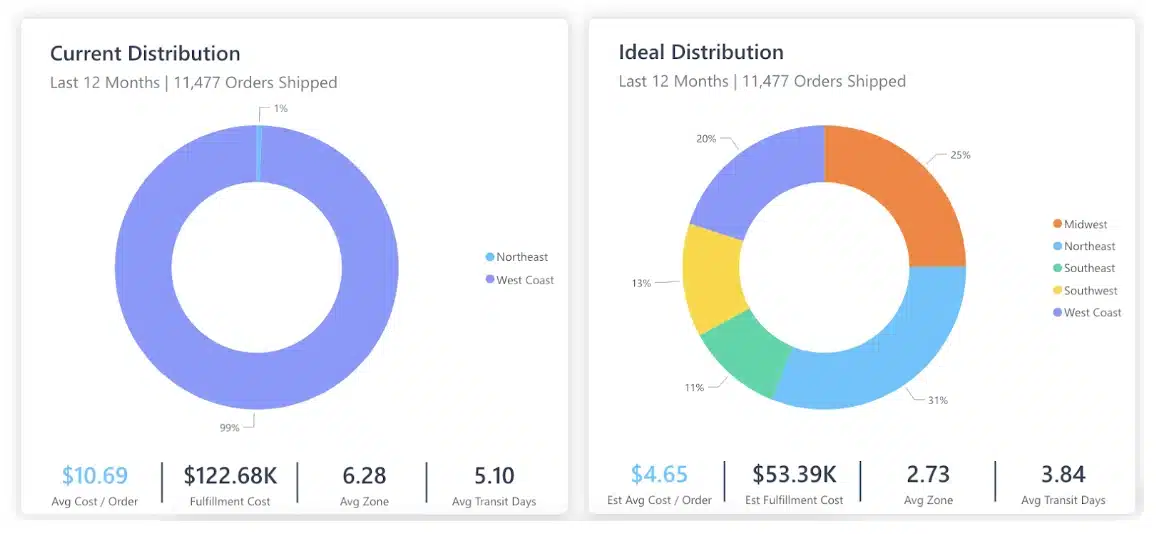
ShipBob Additional Services: Custom Packaging, Kitting, B2B, Returns, and International
Why the extras decide how well a 3PL fits your brand
Basic picking and packing is the starting point. However, the services around it often decide whether a fulfillment partner fits a brand’s real needs. That is why ShipBob’s additional services cover the common requests that growing merchants run into.
Branded packaging and standard supplies
Merchants can use their own custom boxes, mailers, and inserts, while they pay only to store them. Otherwise, ShipBob uses plain brown boxes in many standard sizes. It also uses poly mailers, bubble mailers, tape, dunnage, and shipping labels at no extra packaging line item.
Kitting, B2B, and returns
ShipBob’s fulfillment associates can then assemble kits and bundles once you are approved. Food Huggers’ operations director says offering bundles through ShipBob increased the brand’s overall order value and units sold. ShipBob also fulfills EDI-compliant retailer orders and larger wholesale shipments at an additional cost. Finally, it handles returns for a flat fee that applies when the return physically arrives at the fulfillment center.
Additional services in action: one partner for DTC, retail, and global
Because B2B, returns, and international shipping sit under the same provider, a brand can sell on its own site, ship to retailers, and send orders to 250+ destinations from one inventory pool. Meanwhile, fulfillment centers in the USA, Canada, the UK, Australia, and Europe support that range. In addition, on-site customer support reps at each location help troubleshoot issues.
ShipBob Alternatives: Exploring Top Fulfillment Competitors
When evaluating third-party logistics providers, it is natural to compare ShipBob with other fulfillment options. While each provider has strengths, ShipBob stands out for combining a large distributed network, free software, and a wide set of integrations in one platform.
| Competitor | Their strength | Where ShipBob differentiates |
|---|---|---|
| Amazon Multi-Channel Fulfillment | Uses Amazon’s logistics network and is familiar to sellers already on Amazon | An independent network with unbranded packaging options, custom unboxing, and a single dashboard across your own store, marketplaces, and retail |
| ShipMonk | A full-service ecommerce fulfillment company serving growing online brands | A network of 50+ centers, 2-day shipping across the continental US, and the Inventory Placement Program for splitting stock by region |
| ShipHero | Warehouse management software used by in-house and 3PL warehouses | A combined service: ShipBob provides the warehouses, carrier rates, and software together, and also offers WMS for brands with their own US warehouse |
| Rakuten Super Logistics | An established 3PL for ecommerce order fulfillment | Free software, 50+ turnkey integrations, and added AI tools through ShipBob AI, MCP, and a Claude connection |
Is ShipBob Worth It? A Complete Look at Its Value for Ecommerce Brands
Where ShipBob fits best
Overall, ShipBob’s fulfillment platform is worth considering for any online brand that is outgrowing its own shipping setup. It especially suits brands that want a partner able to scale across regions and channels. It also combines storage, order fulfillment, 2-day shipping, returns, B2B support, and free software. Pricing, however, stays quote-based and tailored to the brand.
Pricing, network, and results
ShipBob is a strong option for growing ecommerce brands looking to reduce shipping costs and speed up delivery. Its 50+ fulfillment centers, Inventory Placement Program, carrier discounts, and free dashboard help streamline logistics. With over 300 million orders fulfilled, a reported 99.97% order accuracy rate and offers a scalable fulfillment solution. Pairing it with a lead generation and marketing program can help drive more orders.
Key Takeaways
- End-to-end fulfillment: Receiving, storage, picking, packing, shipping, and returns come from one provider, so you manage fewer vendors
- A distributed network: 50+ centers and the Inventory Placement Program cut transit time, so delivery gets faster
- Free software and 50+ integrations: The dashboard costs nothing extra, while it connects to stores, marketplaces, and ERPs
- Quote-based pricing: Standard fees plus optional services are then customized to your volume, products, and needs
Frequently Asked Questions
1. What is ShipBob best used for?
ShipBob is an ecommerce fulfillment provider that stores inventory and picks, packs, and ships orders for online brands. It also serves direct-to-consumer, marketplace, and B2B sellers.
2. How much does ShipBob cost?
ShipBob pricing is quote-based. Specifically, standard fees include implementation, receiving, warehousing, and picking, packing, and shipping each order. However, optional services such as kitting and B2B carry additional fees.
3. Does ShipBob charge for its software?
No, ShipBob’s software is free for all customers, including turnkey integrations. Then you use the dashboard to connect your stores and manage inventory, orders, and shipments.
4. Does ShipBob offer international shipping?
Yes, ShipBob ships to more than 250 destinations. However, quotes for international shipping are available on request. It also has fulfillment centers in the USA, Canada, the UK, Australia, and Europe.
5. Can I use my own branded boxes with ShipBob?
Yes, merchants can use their own custom branded boxes, mailers, and inserts. However, they pay only to store them.
6. Does ShipBob provide packing supplies?
Yes, ShipBob uses plain brown boxes in standard sizes. It also uses plain poly mailers, bubble mailers, tape, dunnage, and shipping labels for orders.
7. Does ShipBob offer kitting?
Yes, ShipBob’s fulfillment associates can then perform kitting once approved, so items ship the way you want. Kitting carries an additional cost.
8. Does ShipBob fulfill B2B and wholesale orders?
Yes, ShipBob can fulfill automated EDI-compliant orders and larger wholesale or B2B orders at an additional cost. This includes labeling, pre-paid labels, pallet preparation, and freight quotes.
9. Which carriers does ShipBob work with?
ShipBob says it has negotiated bulk discounts with major carriers such as UPS, USPS, FedEx, and DHL, as well as regional carriers. It then passes those savings on to merchants.
10. How do returns work with ShipBob?
ShipBob offers returns management for a flat fee that covers processing all items in the return. The fee is charged when the return arrives at the fulfillment center. However, buying return labels through ShipBob is optional, so you can use your own.
Ready to Ship Smarter, Faster, and for Less?
Explore how ShipBob can help your brand store, ship, and scale. It also offers a global fulfillment network and free software.
(877) 522-7738
Blogs
Enterprise SEO: How Large Websites Can Scale Rankings Effectively
Large websites don’t win by fixing pages one at a time. Learn how enterprise SEO scales rankings through crawl control, template fixes, safe content scaling and AI search readiness.
How to Customize Sales Popups on Shopify to Match Your Brand
Learn how to customize sales popups on Shopify to match your brand, from colors, fonts, and position to message text, timing, and mobile testing.
How Shopify Sales Notifications Help Build Social Proof and Increase Sales
Learn how Shopify sales notifications build social proof, reduce shopper hesitation, and support sales, plus best practices and how to add them to your store.
Franchise SEO Challenges and How Multi-Location Brands Can Overcome Them
Franchise SEO is mostly a coordination problem. See the 10 challenges multi-location brands face, from duplicate location pages and listing drift to profile ownership and AI search, and how to fix each one at scale.
Google Ads Benchmarks 2026: What the Numbers Actually Mean for Your Account
Google Ads Search averages for 2026 are a 6.64% CTR, $5.42 CPC, 8.18% conversion rate and $66.69 cost per lead. Learn how to find your break-even CPL and which metric is holding your account back.
Best Shopify Sales Popup Apps to Boost Customer Trust and Conversions
Compare seven Shopify sales popup apps on features, customization, pricing, and ease of use, and learn how to pick one that builds trust without guesswork.
Franchise vs Enterprise Digital Marketing: Key Differences & Best Practices
Franchise and enterprise marketing both manage many locations under one brand, but they run on different rules. See who controls the budget, brand and data in each model, and the best practices that work for both.
How to Add a Shopify Sales Popup: Step-by-Step Guide
Learn how to add a Shopify sales popup in seven steps. Pick an app, set display rules, test on mobile, and track whether it works, with no coding needed.
Google Partner Rewards Store Not Working? We Hit a Redirect Loop, and Here’s What to Do
Stuck in a Google Partner Rewards Store redirect loop? Discover the exact causes behind the login bug and practical troubleshooting steps to redeem your partner points.
GloriaFood Is Shutting Down: Your 7-Step Plan and a Replacement to Try
With Oracle discontinuing GloriaFood, restaurants must plan ahead: explore a 7-step migration blueprint, data export tips, and top online ordering replacements.
Best Shopify Image Optimization Apps: How to Choose the Right Tool for Your Store
Learn what to look for in a Shopify image optimization app, the main types of tools, how to compare apps fairly, and the mistakes to avoid when choosing the right one.
Shopify Image Optimization Checklist: What to Do Before and After Uploading Product Photos
Use this Shopify image optimization checklist to prepare product photos before you upload, finish the job after, avoid common mistakes, and handle large catalogs in bulk.
Beehiiv Newsletter Platform: Pricing, Features, and Monetization Tools
Explore the beehiiv newsletter platform to streamline your communication and engage with your audience effectively.
Shopify Core Web Vitals and Images: How to Find and Fix Image-Related Speed Issues
Learn how images affect Shopify Core Web Vitals, how to find image-related speed issues, the most common mistakes, and how to fix them, including for large product catalogs.
Shopify Fake Cart Bot Attack: What Stopped 500+ Fake Carts an Hour (and a Script We Can’t Rule Out)
A client’s Shopify store was hit with 500+ fake carts an hour, and captchas, rate limits and bot apps didn’t stop it. Here’s why the traffic bypassed our security, the one fix that worked, and a third-party script lead we’re still tracing.
Getting information about your case and your options is your FIRST move. Get a FREE case evaluation now…
Find Yourself a Marketing Expert Near You!
(877) 522-7738