
How Shopify App Founders Actually Get Their First 100 Installs
TL;DR:
- The first 100 installs are a different problem than scaling to 1,000. You have no reviews, no case studies, and usually no budget. Every tactic has to work without those crutches.
- App Store Optimization comes before any traffic tactic. With 15,000+ apps in the Shopify App Store, a listing that doesn't convert wastes every install-driving effort that follows it.
- Partnerships and community outreach outperform paid ads at this stage. Paid acquisition is a scaling tool for something already proven to convert, not a discovery tool for an unproven app.
- Reviews and activation are the actual bottleneck, not installs themselves. An install that never reaches real value doesn't become a review, a retained user, or a referral.
Most Shopify app marketing advice is written for apps that already have traction: reviews to lean on, a case study to point to, budget to test paid channels. None of that exists when you're at zero. Getting from zero to 100 installs is a genuinely different problem, and most of what works at that stage looks nothing like what works once you have social proof to build on.
Here's a realistic playbook for that specific stage: what actually moves the needle before you have anything else to lean on. If you're past this stage and ready to scale install volume with a proven listing, our team can help you get there faster than trial and error.
Schedule a Free Strategy Call →
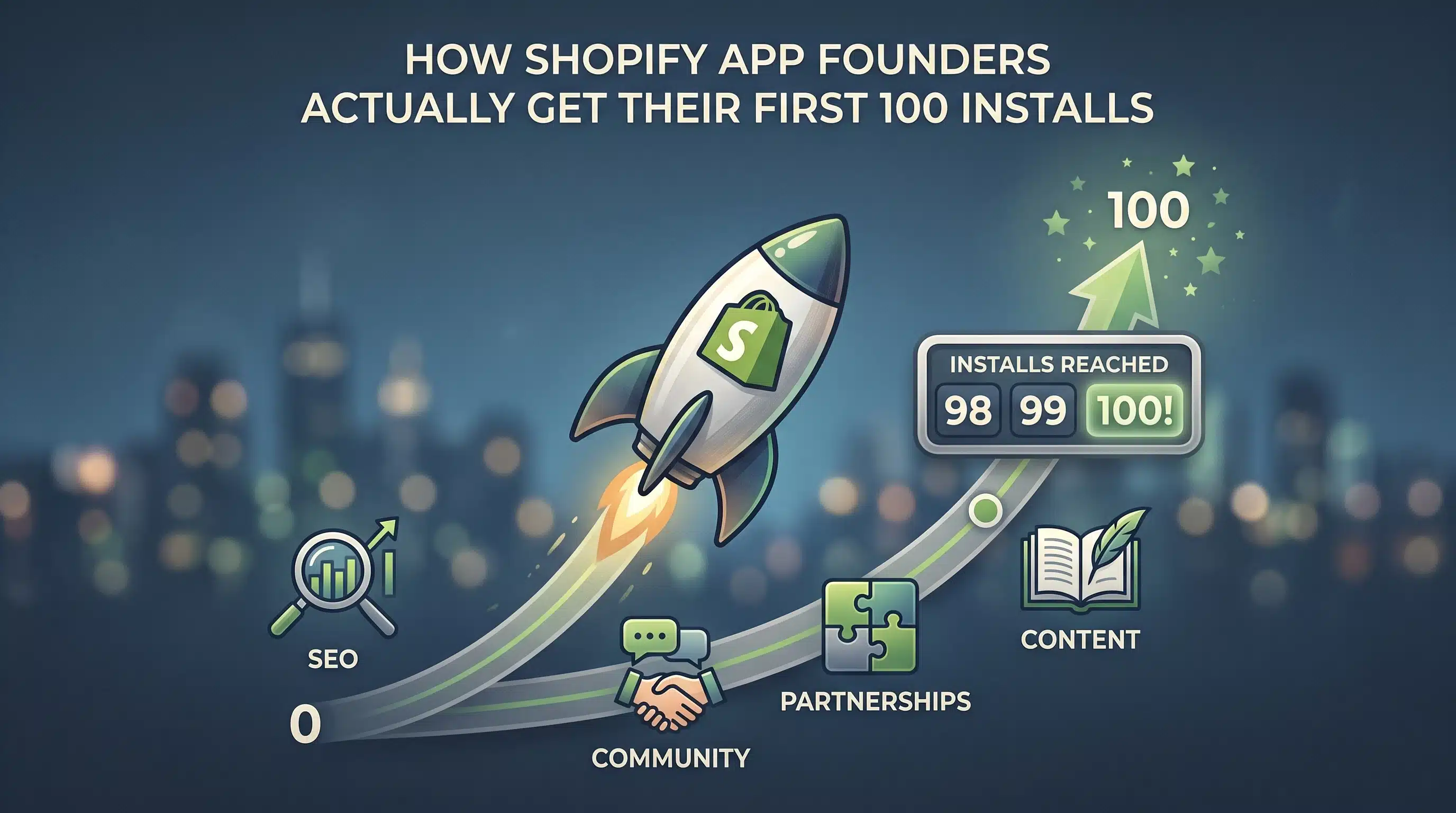
Why the First 100 Is Its Own Problem
With over 15,000 apps now in the Shopify App Store, competition for attention is genuinely high, but the harder problem at zero installs isn't competition, it's credibility. A merchant browsing the App Store has no reviews to check, no install count to reassure them, and no case study proving the app actually does what it claims. Every tactic in this guide is built around that constraint: earning trust without the social proof that normally does the convincing for you.
Step 1: Nail Your App Store Listing Before Anything Else
Your App Store listing functions as a landing page, not documentation, and it's the single highest-leverage thing to fix before driving any traffic toward it, since every other tactic in this guide eventually sends people there.
- Title and subtitle carry the most weight: merchants decide whether to keep reading within the first couple of lines. Lead with the problem you solve, not your feature list
- Screenshots should show outcomes, not settings pages: a screenshot of a results dashboard convinces faster than a screenshot of a configuration screen
- A short demo video showing first-use value does more work than a paragraph of description text
- Write for the merchant's actual pain, not your app's architecture. "Merchants lose trust and conversions because their product pages look empty" is a listing anchor; "built with a modular plugin architecture" is not
Step 2: Get Your First 10 Installs From People You Already Know
Before any public tactic, your existing network is the fastest, most controllable source of your very first installs: past colleagues running Shopify stores, developer communities you're already part of, or beta merchants recruited directly through a personal ask rather than a public listing. These early installs matter less for volume and more for what they unlock next: genuine usage data, your first honest feedback, and, critically, your first real reviews.
Step 3: Show Up in the Shopify Community, For Real
The Shopify Community forums, the Shopify Partner ecosystem, and relevant subreddits and developer Slack/Discord groups are full of merchants and other app builders actively discussing exactly the problems your app solves. This only works as genuine participation: answering real questions, contributing before promoting. Not as disguised self-promotion, which gets noticed and discounted quickly in these communities. The same instinct applies to Social Media Marketing more broadly: showing up consistently with something useful beats a single promotional push.
Step 4: Partner With Agencies and Theme Developers
Partnerships are increasingly outperforming paid ads specifically for early-stage B2B SaaS and Shopify apps, and it's worth treating this as a core channel rather than a side effort. Shopify agencies and theme developers work directly with the merchants you're trying to reach, and a recommendation from a trusted implementation partner carries far more weight at this stage than an ad a merchant has never seen the brand behind before, the same relationship-building logic behind good Digital PR Services.
Step 5: Chase Activation, Not Just Installs
An install that never reaches real value is worth almost nothing. It won't become a review, a retained user, or a referral. Define one specific activation milestone that proves your app is actually working for that merchant (publishing a widget, completing a first sync, launching a first rule), and strip your onboarding down to the shortest possible path to that moment. Once a merchant hits it, ask directly for a review while the value is still fresh. Don't wait and hope it happens organically, the same proactive approach good Online Reputation Management takes toward earning reviews rather than waiting for them.
Step 6: Write Content That Solves One Real Merchant Problem
Content built around a single, specific merchant pain point (not a broad "why our app is great" post) does double duty: it earns organic search visibility over time, and it gives you something genuinely useful to share in the communities from Step 3, rather than a bare app link. Our content marketing and SEO content writing teams build exactly this kind of problem-first content for SaaS and app clients.

Step 7: Save Paid Ads for After You Have Proof
Paid channels like Shopify Search Ads are a scaling tool for something already proven to convert, not a discovery tool for testing whether an unproven app resonates. Spending on ads before your listing converts organically, or before you have reviews to reassure a paid-traffic visitor, generally just buys expensive traffic to a leaky page. Once your listing and activation flow are dialed in, our ecommerce PPC and Google Ads management teams can help you scale install volume with a much clearer expected return.
Common Mistakes Founders Make Chasing Installs
- Driving traffic to an unoptimized listing before fixing the title, subtitle, and screenshots. Every other tactic's effort gets wasted on a page that doesn't convert
- Treating paid ads as a discovery tool instead of a scaling tool, spending budget before there's any proof of organic conversion
- Overbuilding onboarding instead of shortening the path to one clear activation moment
- Self-promoting in communities without first contributing genuine value, which gets discounted or removed quickly
- Chasing install count instead of activation rate, ending up with installs that never convert into reviews, retention, or referrals
Where to Start This Week
If you're currently at or near zero, spend this week entirely on your listing (Step 1) and your first 10 personal-network installs (Step 2). Everything else in this guide depends on having a listing that converts and a handful of early, honest reviews to point to. Resist the urge to jump to paid ads or broad content marketing before those two things are in place, the same disciplined sequencing a real Digital Marketing Strategy Development process would insist on rather than trying everything at once.
Key Takeaways
- Credibility, not competition, is the real barrier at zero installs. Every tactic should be building trust without social proof
- Fix your listing before driving any traffic to it. It's the foundation every other channel depends on
- Partnerships and genuine community participation outperform ads at this specific stage
- Activation, not install count, is the metric that actually predicts long-term growth
Frequently Asked Questions
1. Should I use paid ads to get my first 100 Shopify app installs?
Generally not yet. Paid ads work best as a scaling tool for something already proven to convert organically. Spending on ads before your listing and onboarding are dialed in usually just buys expensive traffic to a page that doesn't convert.
2. How important is App Store Optimization for a brand-new app?
It's the foundation everything else depends on. With 15,000+ competing apps, a listing that doesn't clearly communicate the problem you solve wastes the effort behind every other traffic-driving tactic, which is really just Conversion Rate Optimization applied to an App Store listing instead of a website.
3. Where should my very first installs come from?
Your existing personal and professional network: past colleagues, developer communities you're already part of, or directly recruited beta merchants. These early installs matter most for the feedback and first reviews they generate, not for volume.
4. How do I get reviews when I don't have any users yet?
Define a clear activation milestone that proves your app is working, shorten onboarding to reach it as fast as possible, and ask directly for a review the moment a merchant hits that milestone, while the value is still fresh.
5. Are Shopify agency partnerships actually worth pursuing this early?
Yes. Partnerships increasingly outperform paid ads for early-stage Shopify apps, since agencies and theme developers already work directly with merchants in your target audience and their recommendation carries more trust than an unfamiliar ad, the same principle behind structured Affiliate Marketing Services once the relationship is formalized.
6. What's the biggest mistake founders make trying to grow installs?
Driving traffic, paid or organic, to an unoptimized App Store listing before fixing the fundamentals, which wastes the effort behind every other tactic layered on top of it.
Ready to Turn Your First Installs Into Real Growth?
Get a free strategy call to map out exactly which channels make sense for your app's current stage, no generic playbook, just what actually fits where you are right now.
(877) 522-7738
Blogs
How to Validate Shopify Structured Data
Learn how to validate Shopify structured data with Google’s Rich Results Test, Schema Markup Validator, and Search Console to find and fix common schema errors step by step.
JSON-LD vs. Microdata: Differences for Shopify
Compare JSON-LD vs. Microdata for Shopify. Learn how each format works, which is easier to maintain, how they handle Product Schema, and how to validate your structured data.
Imagify for WordPress: Features, Pricing & a $6/Month Deal for 1,000 MB (2026)
Imagify for WordPress automatically compresses images, converts them to WebP/AVIF, and improves site speed with off-server optimization.
Is $10 a Day Enough for Google Ads? A Realistic Breakdown
A $10-a-day Google Ads budget works only when tightly targeted to local, low-CPC niches, while competitive industries require higher spend for data learning.
Filevine Case Management: Top Benefits for Growing Law Firms
Filevine case management software offers powerful AI tools and deep customization, making it ideal for high-volume personal injury and litigation firms.
Shopify Review Schema: Ratings and Structured Data
Learn how Shopify review schema works, how to add ratings and reviews to Product JSON-LD, validate markup, and fix common structured data issues.
SMBMarket Review 2026: Is It Worth $67/Mo for Business Buyers?
SMBMarket aggregates business-for-sale listings, deal tools, and coaching for $67 a month, serving as a consolidated platform for prospective business buyers.
How to Fix Missing validFrom in Merchant Listings
Learn how to fix missing validFrom errors in Google Merchant Listings, when the property is required, how to add it to Shopify JSON-LD, and how to validate the fix.
Shopify Product Schema vs. Google Merchant Listings
Shopify Product Schema vs. Google Merchant ListingsNEED HELP? CONTACT US 24/7 (877) 522-7738 Industries We Serve Law Firms & Legal Services Healthcare & Medical Practices Technology & SaaS Companies E-Commerce & Retail Home Service Finance Free...
How Many Billable Hours Does a Home Care Agency Need to Hire a Marketing Agency?
Instead of relying on a universal billable hours benchmark, home care agencies should determine marketing readiness using their margin per hour, payer mix, and operational capacity.
AppLovin Ads: Features, Pricing & Mobile App Advertising
AppLovin Ads: Features, Pricing & Mobile App AdvertisingNEED HELP? CONTACT US 24/7 (877) 522-7738 Industries We Serve Law Firms & Legal Services Healthcare & Medical Practices Technology & SaaS Companies E-Commerce & Retail Home Service Finance Free...
Gushwork: AI SEO, GEO, Pricing, Features & Alternatives
Gushwork: AI SEO, GEO, Pricing, Features & AlternativesNEED HELP? CONTACT US 24/7 (877) 522-7738 Industries We Serve Law Firms & Legal Services Healthcare & Medical Practices Technology & SaaS Companies E-Commerce & Retail Home Service Finance Free...
Shopify Rich Snippets: Setup and Troubleshooting
Shopify Rich Snippets: Setup and Troubleshooting ============================================================================ Shopify Rich Snippets: Setup and Troubleshooting (new DMB design) Main link (plain, same attributes as the other pages):...
How to Add Product Schema to Shopify
How to Add Product Schema to Shopify: A Step-by-Step GuideNEED HELP? CONTACT US 24/7 (877) 522-7738 Industries We Serve Law Firms & Legal Services Healthcare & Medical Practices Technology & SaaS Companies E-Commerce & Retail Home Service Finance Free...
Before You Pay $10K+/Month for Personal Injury SEO, Ask This Exclusivity Question
Because local search rankings are zero-sum, personal injury law firms must verify agency exclusivity in their geographic market before committing to costly SEO retainers.
Getting information about your case and your options is your FIRST move. Get a FREE case evaluation now…
Find Yourself a Marketing Expert Near You!
(877) 522-7738