
Slow Shopify Store? How Image Compression Can Help Improve Page Speed
TL;DR:
- What it is: Image compression makes your Shopify image files smaller, so there is less to download. When it’s done carefully, your images still look good.
- What it does: Smaller files help pages load faster, especially on phones. They can also support better Core Web Vitals, such as Largest Contentful Paint (LCP).
- What it can’t do: Compression is one part of a faster store, not a cure-all. Apps, scripts, fonts, and theme code also affect speed, so test before and after.
- How to scale it: For large catalogs, SEO Image Optimizer by DMB automates compression, bulk processing, and new uploads. Also, its free plan covers up to 500 images.
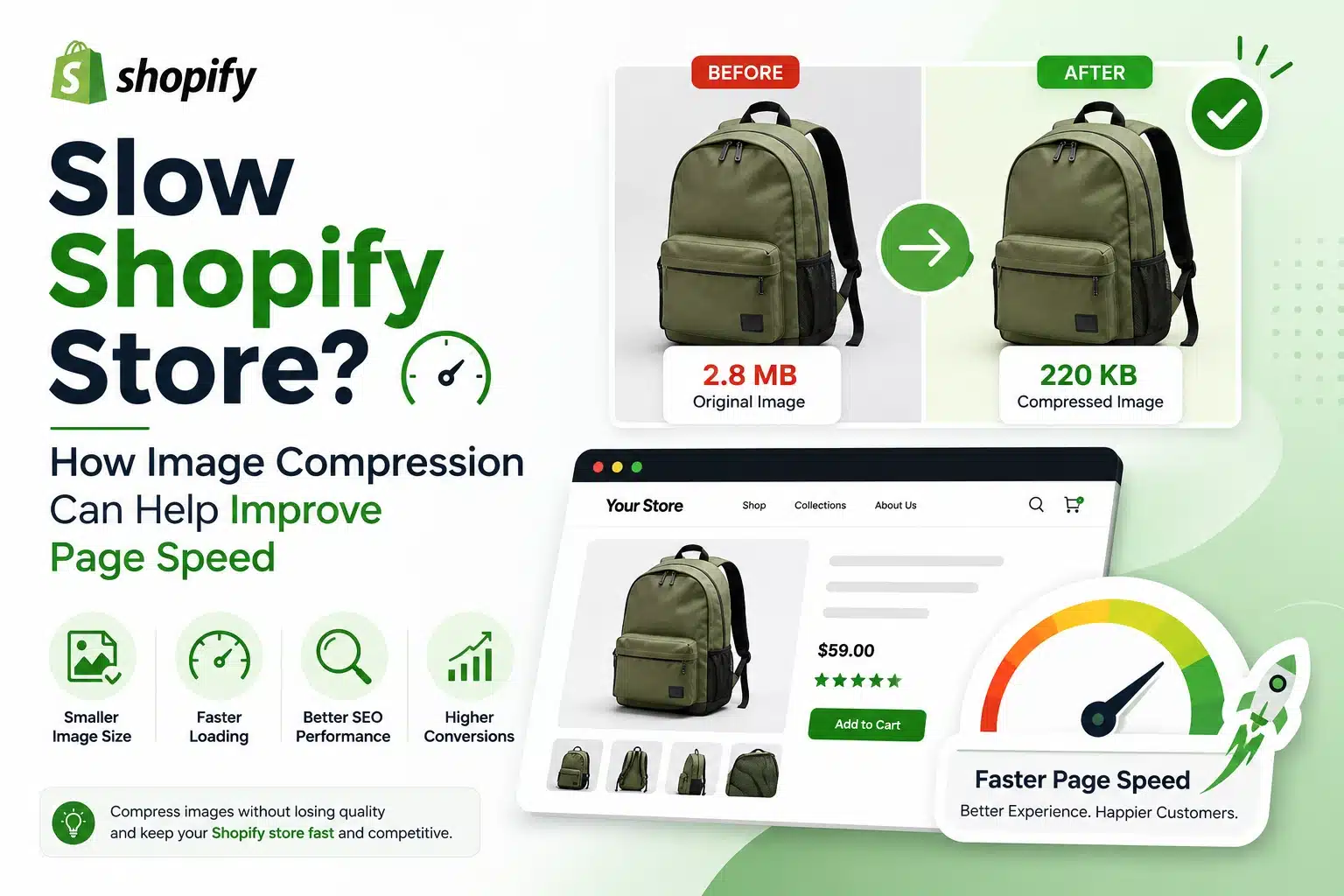
If your Shopify store feels slow, there’s a good chance images are part of the reason. Product galleries, collection grids, and banners are made of image files, and when those files are far bigger than they need to be, shoppers wait longer for every page, especially on a phone.
Image compression is one practical way to fix that. It makes files smaller so there’s less to download, and when it’s done carefully, the images still look good.
This guide explains why stores load slowly, how compression works, how it can help page speed, and how to apply it step by step. It also shows how to check whether your changes made a real difference, and where automation can save time on a large catalog.
Why Is Your Shopify Store Loading Slowly?
Slow pages rarely have just one cause. Therefore, it helps to know where the weight comes from before you change anything.
Large product and banner images
A single unoptimized photo can be several megabytes. Multiply that by a product gallery, a collection grid, and a hero banner. As a result, the browser has a lot to download before the page feels ready.
Unoptimized formats and dimensions
Uploading a 5000-pixel-wide image that displays at 800 pixels wastes bandwidth. Saving photos as PNG when JPEG would do has a similar effect.
Other factors: apps, scripts, and theme code
Images aren’t the only cause. Third-party apps, tracking scripts, custom fonts, and heavy theme code can all slow a store down. That’s why testing matters, because it shows where your time is going before you start changing things. Ongoing website maintenance services can also keep apps and scripts under control.
What Is Image Compression and How Does It Work?
Image compression reduces a file’s size by storing the same picture more efficiently. It comes in two main kinds. When done well, it is also a quiet win for technical SEO services work.
Lossy vs. lossless compression
Lossless compression shrinks a file without discarding any image data. Quality is unchanged, but the savings are smaller. In contrast, lossy compression removes detail the eye is unlikely to notice, and it usually saves much more. For product photos, a moderate lossy setting is common, as long as you check the results.
Reducing file sizes while maintaining visual quality
The goal isn’t the smallest possible file. Instead, it’s the smallest file that still looks right. Compress, then zoom in on edges, textures, and any text on the product.
Why it matters for ecommerce stores
Shoppers judge products by their photos, so you can’t trade clarity for speed carelessly. Good compression keeps detail while cutting the weight. As a result, pages load faster and products still look their best.
How Image Compression Improves Shopify Page Speed
Compression helps speed in a few specific ways. A deeper check with our SEO audit services can also show which pages gain the most.
It reduces the amount of image data that needs to load
Smaller files mean fewer bytes to transfer. On image-heavy pages like collections, that can be a large share of the total download.
It helps loading performance on mobile devices
Phones often run on slower or less stable connections, so heavy images hurt them most. Lighter files, therefore, give mobile shoppers a better chance of seeing your products quickly.
It can support better Core Web Vitals
Largest Contentful Paint (LCP) measures how long the largest visible element takes to appear. On many product and home pages, that element is an image. Google treats an LCP of 2.5 seconds or less as good. Compressing a large main image can help. However, your LCP also depends on hosting, scripts, and how the theme loads content.
It creates a smoother browsing experience
When images arrive faster, pages feel more responsive. Shoppers can scroll, zoom, and compare products without waiting. That supports a better experience, though it doesn’t guarantee higher rankings or sales.
How to Compress Images and Speed Up Your Shopify Store
Resize images to appropriate dimensions
Start by resizing. Shopify’s guidance says 2048 × 2048 px usually looks best for square product images, and anything much larger just adds weight. Resizing first, therefore, makes compression more effective. Professional product photography services can also help you start with the right dimensions.
Choose suitable image formats
JPEG works well for product photos, PNG for graphics and transparency, and WebP for smaller files at similar quality. Shopify can serve WebP to compatible browsers automatically. As a result, you don’t have to convert every source file yourself.
Compress product photos without losing important details
Pick a moderate setting, compress a test image, and zoom in. If edges look smudged or gradients look blocky, ease off. Detail-heavy products need gentler compression than flat-color ones.
Use responsive delivery and appropriate lazy loading
Shopify themes can deliver different image sizes to different screens. Meanwhile, lazy loading holds back images below the fold until needed. The main image at the top of the page should not be lazy loaded, since delaying it can hurt LCP. A well-built theme, such as one from our Shopify web design services team, handles both.
Audit existing images and test key pages
Find your largest files and your most-visited pages first, since that’s where compression pays off most. For the full process, see our guide to How to Optimize Product Images on Shopify for Better SEO and Faster Loading. Our ecommerce optimization services can also help you decide which pages to fix first.
How to Check Whether Image Compression Improves Your Shopify Speed
Test product and collection pages with Google PageSpeed Insights
Enter the URL of a key product page and a collection page, and run the test. Review mobile and desktop results separately, since mobile is usually the harder one. PageSpeed Insights also lists opportunities, such as properly sized or efficiently encoded images.
Review LCP and other Core Web Vitals
Look at Largest Contentful Paint first, since images often drive it. Note which element is the LCP element. If it’s your main product image or hero banner, that’s the file to prioritize.
Compare results before and after
Record your numbers before you change anything. Then test the same pages again afterward. Scores vary from run to run, so test a few times and look for a consistent trend. Tracking real shopper behavior with Google Analytics services also shows whether faster pages help engagement.
Here is a hypothetical example, although your results will differ:
| Measure | Before | After |
|---|---|---|
| Total image weight | 4.8 MB | 1.9 MB |
| Largest Contentful Paint (mobile) | 4.1 s | 2.7 s |
Automate Shopify Image Compression with SEO Image Optimizer by DMB
Compressing a few images by hand is fine. However, compressing thousands, and then keeping up with every new upload, is the kind of repetitive work that tends to get skipped.
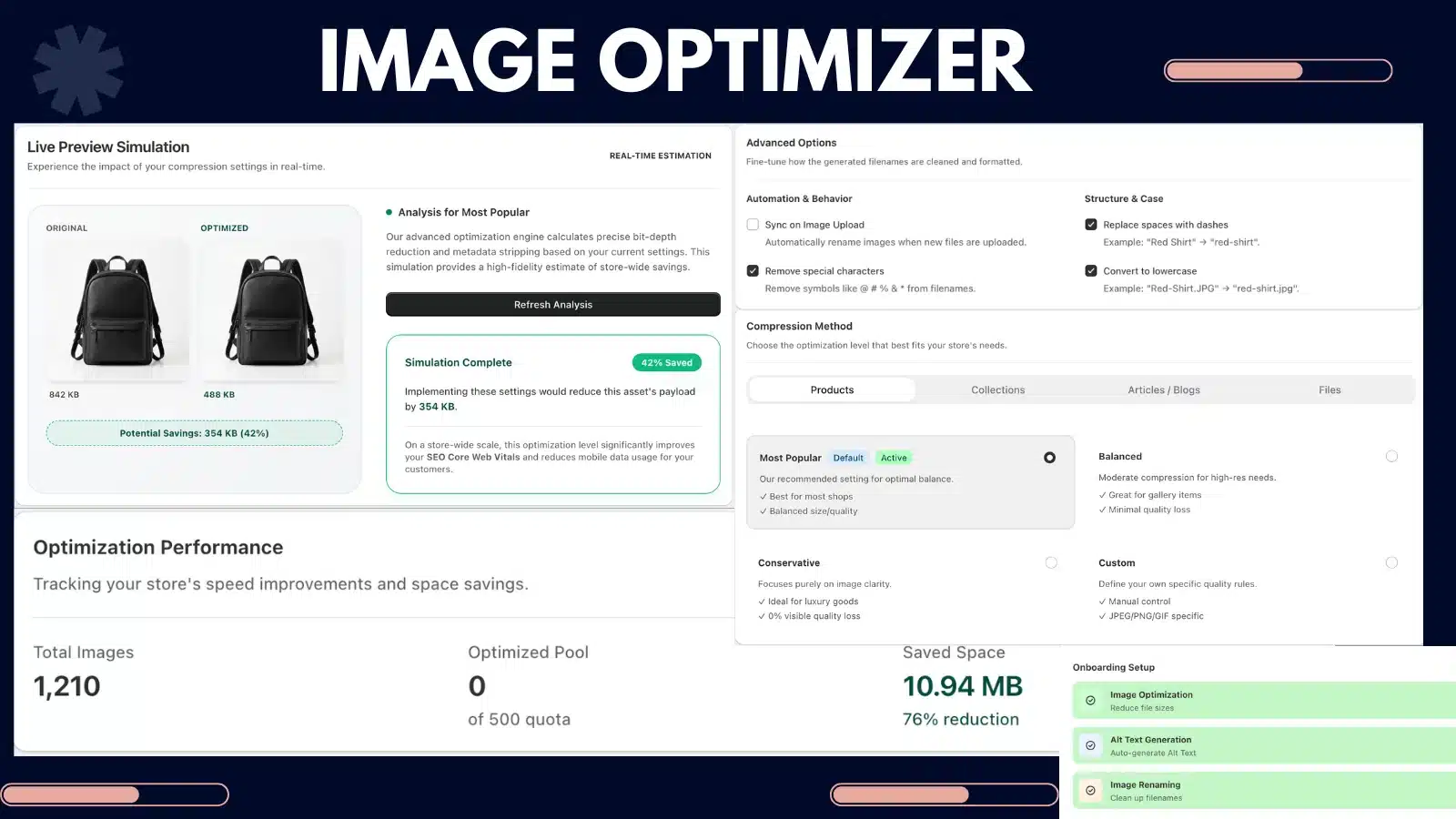
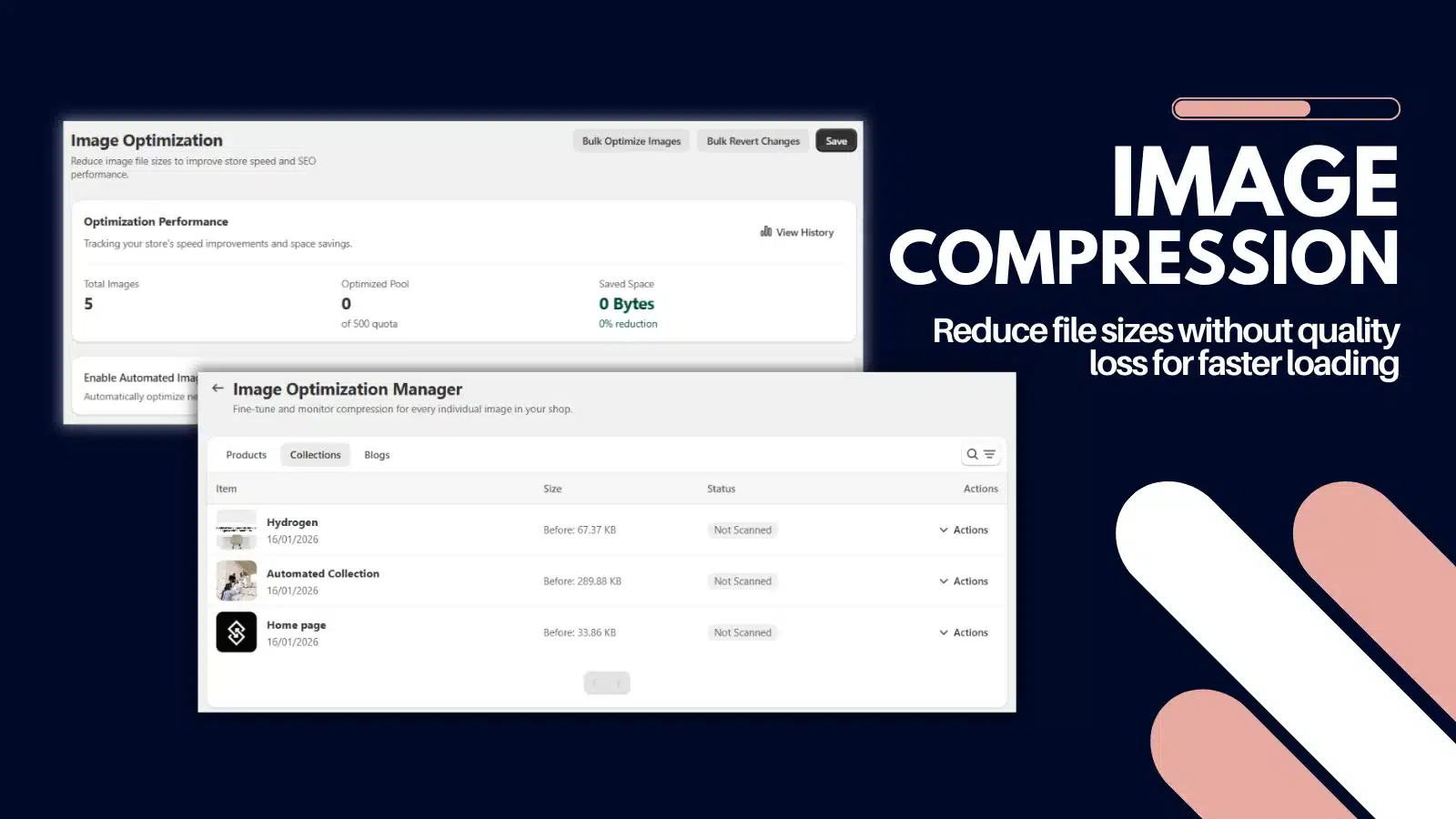
SEO Image Optimizer by DMB is a Shopify app built to take that work over. Its listing describes:
- Image compression: Reduces file sizes without a visible drop in quality, so page speed improves
- Bulk optimization: Processes your existing catalog in one go
- Automation: Syncs and optimizes new uploads as they’re added
- Alt-text and filename tools: Generates alt text and renames files using custom templates, so speed and SEO housekeeping happen together
A free plan covers up to 500 images, and paid plans raise the limit. Check the listing for current pricing. Our Shopify SEO services team can also help you plan the wider image and speed strategy.
Watch: Set Up Image Compression in SEO Image Optimizer (Video Tutorial)
Prefer to see it in action? This walkthrough shows how to install SEO Image Optimizer by DMB and configure image compression first. It then covers alt text, automation, renaming, the theme speed checklist, and performance metrics.
Explore SEO Image Optimizer by DMB Free on Shopify →
Compression supports a lighter store. However, it can’t guarantee a particular speed score, ranking, or sales result.
Frequently Asked Questions
1. Does image compression improve Shopify page speed?
Usually, yes, because smaller files download faster, especially on mobile. However, speed also depends on apps, scripts, fonts, and theme code. So compression helps most when images are a big part of the problem. Our ecommerce SEO services team can pinpoint the biggest causes.
2. How do I compress product images on Shopify?
Resize images to sensible dimensions, then compress them with an image editor, a compression tool, or an app. Check the results by zooming in on fine detail. For large catalogs, an automated app saves time.
3. Does Shopify automatically optimize images?
Shopify’s image delivery can serve resized versions and modern formats like WebP to compatible browsers. However, it doesn’t replace preparing sensible source files. So resizing and compressing before upload still gives you more control over quality.
4. Can image compression improve Core Web Vitals?
It can help, particularly LCP when a large image is your largest visible element. However, it won’t fix every issue, since Core Web Vitals also depend on scripts, layout shifts, and responsiveness. Measure before and after to see the effect.
5. What is the best image format for Shopify?
JPEG works well for most product photos, PNG suits graphics and transparency, and WebP can offer smaller files at similar quality. Since Shopify can serve WebP to compatible browsers, you don’t need to convert every source image.
Final Thoughts: Make Your Shopify Store Faster with Image Compression
A faster store starts with image basics. That means files that aren’t larger than they need to be, dimensions that match how they’re displayed, and testing that shows whether your changes helped.
Compression is one part of a broader speed strategy. Pair it with a lean theme, a close look at your apps and scripts, and regular testing on mobile. In addition, a theme built on responsive web design principles makes that easier.
If manual compression is eating your time, SEO Image Optimizer by DMB can handle compression, bulk processing, and new uploads for you. Faster product pages also support conversion rate optimization goals.
Key Takeaways
- Compression cuts what shoppers download: Smaller files help pages load faster, especially on phones
- Quality still comes first: Compress, then zoom in, so detail never suffers for speed
- Resize before you compress: About 2048 px square usually looks best, and anything larger just adds weight
- Test before and after: Use PageSpeed Insights, watch LCP, and look for a consistent trend
- Automate when the catalog grows: An app can handle bulk work and new uploads, but compression alone can’t guarantee scores, rankings, or sales
Explore SEO Image Optimizer by DMB on the Shopify App Store →
(877) 522-7738
Blogs
Enterprise SEO: How Large Websites Can Scale Rankings Effectively
Large websites don’t win by fixing pages one at a time. Learn how enterprise SEO scales rankings through crawl control, template fixes, safe content scaling and AI search readiness.
How to Customize Sales Popups on Shopify to Match Your Brand
Learn how to customize sales popups on Shopify to match your brand, from colors, fonts, and position to message text, timing, and mobile testing.
How Shopify Sales Notifications Help Build Social Proof and Increase Sales
Learn how Shopify sales notifications build social proof, reduce shopper hesitation, and support sales, plus best practices and how to add them to your store.
Franchise SEO Challenges and How Multi-Location Brands Can Overcome Them
Franchise SEO is mostly a coordination problem. See the 10 challenges multi-location brands face, from duplicate location pages and listing drift to profile ownership and AI search, and how to fix each one at scale.
Google Ads Benchmarks 2026: What the Numbers Actually Mean for Your Account
Google Ads Search averages for 2026 are a 6.64% CTR, $5.42 CPC, 8.18% conversion rate and $66.69 cost per lead. Learn how to find your break-even CPL and which metric is holding your account back.
Best Shopify Sales Popup Apps to Boost Customer Trust and Conversions
Compare seven Shopify sales popup apps on features, customization, pricing, and ease of use, and learn how to pick one that builds trust without guesswork.
Franchise vs Enterprise Digital Marketing: Key Differences & Best Practices
Franchise and enterprise marketing both manage many locations under one brand, but they run on different rules. See who controls the budget, brand and data in each model, and the best practices that work for both.
How to Add a Shopify Sales Popup: Step-by-Step Guide
Learn how to add a Shopify sales popup in seven steps. Pick an app, set display rules, test on mobile, and track whether it works, with no coding needed.
Google Partner Rewards Store Not Working? We Hit a Redirect Loop, and Here’s What to Do
Stuck in a Google Partner Rewards Store redirect loop? Discover the exact causes behind the login bug and practical troubleshooting steps to redeem your partner points.
GloriaFood Is Shutting Down: Your 7-Step Plan and a Replacement to Try
With Oracle discontinuing GloriaFood, restaurants must plan ahead: explore a 7-step migration blueprint, data export tips, and top online ordering replacements.
Best Shopify Image Optimization Apps: How to Choose the Right Tool for Your Store
Learn what to look for in a Shopify image optimization app, the main types of tools, how to compare apps fairly, and the mistakes to avoid when choosing the right one.
Shopify Image Optimization Checklist: What to Do Before and After Uploading Product Photos
Use this Shopify image optimization checklist to prepare product photos before you upload, finish the job after, avoid common mistakes, and handle large catalogs in bulk.
Beehiiv Newsletter Platform: Pricing, Features, and Monetization Tools
Explore the beehiiv newsletter platform to streamline your communication and engage with your audience effectively.
Shopify Core Web Vitals and Images: How to Find and Fix Image-Related Speed Issues
Learn how images affect Shopify Core Web Vitals, how to find image-related speed issues, the most common mistakes, and how to fix them, including for large product catalogs.
Shopify Fake Cart Bot Attack: What Stopped 500+ Fake Carts an Hour (and a Script We Can’t Rule Out)
A client’s Shopify store was hit with 500+ fake carts an hour, and captchas, rate limits and bot apps didn’t stop it. Here’s why the traffic bypassed our security, the one fix that worked, and a third-party script lead we’re still tracing.
Getting information about your case and your options is your FIRST move. Get a FREE case evaluation now…
Find Yourself a Marketing Expert Near You!
(877) 522-7738