
Virtual Legal Staffing: How Tools Like Legal Soft Are Changing the Industry
TL;DR:
- What it is: virtual legal staffing connects law firms with dedicated, remote legal support, such as intake specialists, case managers, and paralegals, without the cost of in-house hiring.
- What it does: gives firms full-time, dedicated staff at a flat monthly rate, typically 60–70% below the cost of an equivalent in-house hire once salary, benefits, and overhead are factored in.
- What it costs: providers like Legal Soft price full-time roles from roughly $2,227–2,922/month depending on the role, working out to a $13–17/hour equivalent to the firm.
- What to verify before signing: who employs the staff member, how compensation and margin actually break down, and how much control your firm has over training and quality. This varies more between providers than the marketing pages suggest.
Law firms have historically had two staffing options: hire in-house, or outsource to a general virtual assistant service that doesn’t understand legal workflows. Virtual legal staffing is a third category that’s grown quickly because it solves both problems at once: dedicated, full-time support trained specifically in legal work, at a fraction of in-house cost. Legal Soft is one of the more visible examples of this model, but understanding how the model works generally will help you evaluate it and its competitors properly.
Here’s how virtual legal staffing actually works, what it costs, and what’s worth verifying before you sign a contract. Our team at DiscoverMyBusiness helps growing firms evaluate operational investments like this against real workload data.
Get a Free Legal Operations Review →
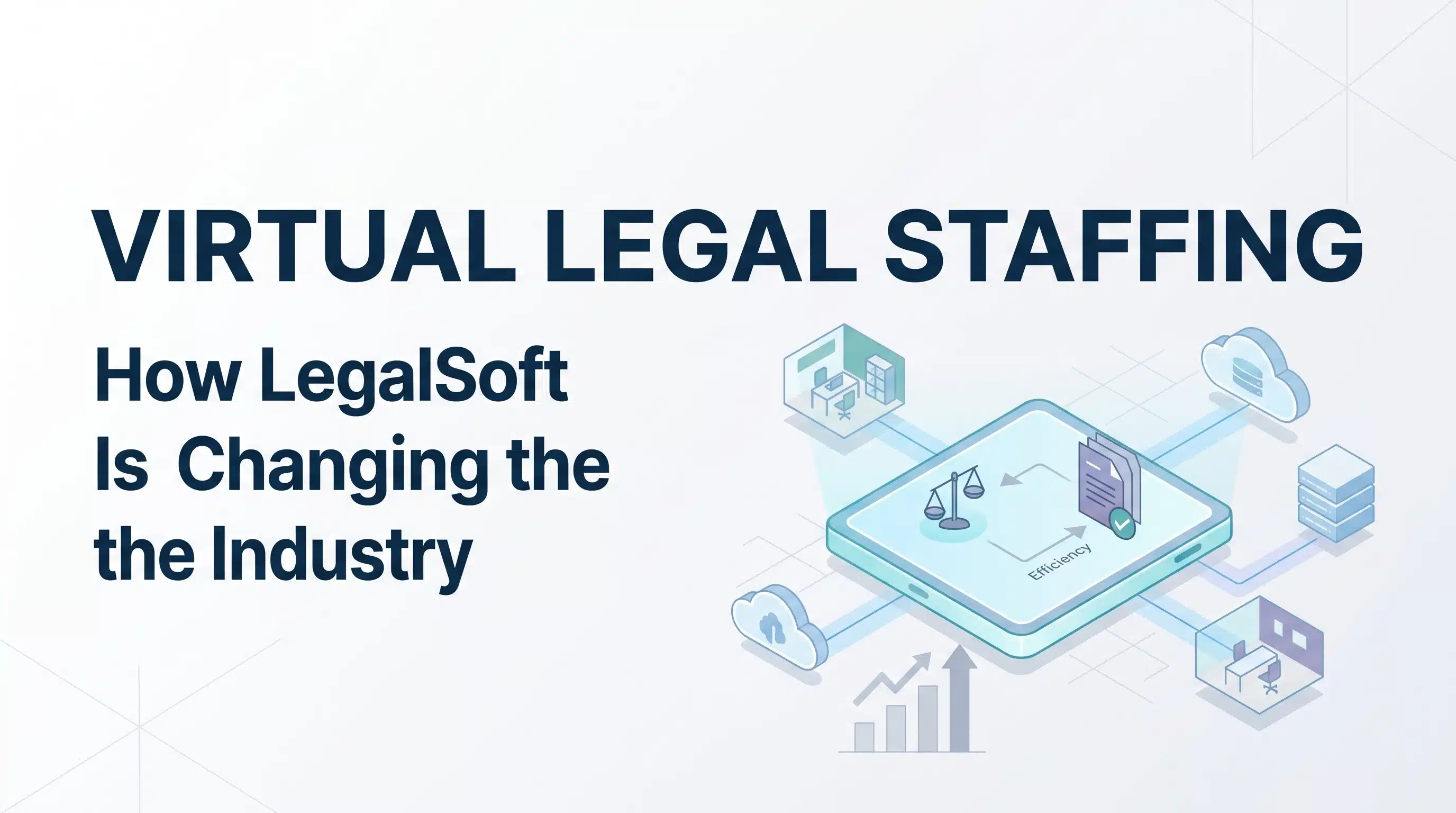
What Is Virtual Legal Staffing?
Virtual legal staffing places remote, dedicated staff, typically intake specialists, case managers, or paralegals, into a law firm’s daily operations, trained specifically in legal workflows rather than general administrative support. The distinguishing feature versus a general virtual assistant service is legal-specific training: case law familiarity, compliance awareness, and the ability to work directly inside legal case management software rather than needing everything translated into generic tasks.
The Economics: Why Firms Are Making the Switch
An in-house legal assistant in the U.S. typically costs $50,000 to $80,000 annually once salary alone is counted, before adding benefits, office space, equipment, and HR overhead. Virtual legal staffing providers commonly position their pricing at up to 70% less than that fully-loaded in-house cost, which is the core economic argument driving adoption, not that virtual staff necessarily outperform in-house hires, but that firms can access comparable legal-specific support at a significantly lower total cost, particularly useful for growing firms not yet ready to commit to full in-house headcount.
How Legal Soft Specifically Works
- Model: a managed-services (BPO) structure where Legal Soft remains the employer of record, and firms pay a flat monthly fee rather than hourly billing
- Roles offered: intake specialists, case managers, paralegals, and demand writers, among others
- Pricing: starting around $2,227/month for intake specialist roles, with case manager and paralegal roles priced higher (roughly $2,525 and $2,922/month respectively based on published and third-party estimates)
- Training claim: staff trained by U.S.-based attorneys, with stated understanding of case law, legal ethics, and compliance requirements
- Software integration: staff work directly inside the firm’s existing case management software rather than requiring a separate system
- Flexibility features: no long-term contract lock-in, a one-click bonus/raise feature for rewarding staff performance, and fast replacement if a placement isn’t working out
- Scale: reportedly placed virtual staff in 1,000+ law firms nationwide
Which Firms Benefit Most
Solo and small firm owners
Firms not yet at the volume to justify a full in-house hire, but drowning in administrative or intake work, get dedicated support without the fixed cost commitment of a traditional employee.
Growing mid-size firms scaling case volume
Firms whose case volume is outpacing their current staff can add dedicated capacity quickly, without the multi-week hiring and onboarding cycle a traditional in-house search typically requires, a common pressure point across Law Firms & Legal Services generally.
Firms with intake bottlenecks specifically
Since intake speed directly affects conversion of leads into signed clients, adding dedicated intake capacity is often one of the highest-ROI virtual staffing use cases available, which is exactly why intake speed is such a core focus of good Lead Generation Services work in the first place.
Flat-Rate vs. Hourly Staffing Models
| Provider | Pricing model | Trade-off |
|---|---|---|
| Legal Soft | Flat monthly rate (~$2,227–2,922/month), dedicated full-time staff | Predictable cost, but less flexible for firms with fluctuating or seasonal workload |
| Legal Staffing Pros | Hourly, starting around $12/hour | More flexible for project-based work, but staff may work with multiple clients and availability can vary |
| Scale Up Staffing | Hourly, starting around $11/hour, full-time or part-time | Fast hiring (candidates within 24 hours, onboarding in ~72 hours), no long-term contract requirement |
| Remote Legal Staffing | Hourly-based, includes bar-certified attorneys from other countries for select tasks | Broader role range, but generally positioned for short-term rather than dedicated long-term support |
What to Vet Before Choosing a Provider
- Employer of record status: know whether the provider or your firm carries employment-related liability and compliance responsibility
- Actual training verification: ask specifically what legal training staff receive and from whom, rather than accepting a general marketing claim
- Data security practices: confirm how client and case data is protected, especially for staff accessing case management systems remotely
- Contract flexibility: understand cancellation terms and replacement policies if a placement isn’t working out
- Compensation transparency: ask directly how much of your monthly fee goes to the actual staff member versus the provider’s margin. Not always disclosed upfront

The Transparency Question Worth Asking
One independent review raised a point worth factoring into due diligence with any virtual staffing provider, not just Legal Soft specifically: the review found job postings from an apparently affiliated recruiting brand advertising legal support roles at $5–9/hour to the workers themselves, while firms pay a flat monthly rate working out to roughly $13–17/hour on the client side. Legal Soft does not publicly disclose staff compensation, so this spread is drawn from third-party research rather than confirmed company disclosure. This isn’t necessarily disqualifying (a margin between what a firm pays and what a worker earns is standard in any staffing model), but it’s a fair, specific question to ask any provider directly: what’s the actual compensation structure, and how does the provider ensure staff retention and quality at that margin?
Is Virtual Legal Staffing Worth It?
For firms with a genuine capacity gap (more intake or case management work than current staff can handle, but not yet ready for a full in-house hire), yes, the economics are compelling and the model has matured enough to have real track records to evaluate. The key to getting real value is treating provider selection with the same diligence as a traditional hire: verifying training, compensation structure, and data security rather than accepting the marketing page at face value, the same rigor a sound Digital Marketing Strategy Development process applies to any vendor decision, not just marketing ones.
Key Takeaways
- The core value proposition is cost, not necessarily superior quality. Roughly 60–70% below fully-loaded in-house cost
- Flat-rate dedicated models and hourly flexible models solve different problems. Match the model to whether your workload is steady or fluctuating
- Compensation transparency varies by provider and is worth asking about directly rather than assuming
- Intake-specific placements often show the clearest ROI, given the direct link between intake speed and client conversion
Frequently Asked Questions
1. What’s the difference between virtual legal staffing and a general virtual assistant service?
Virtual legal staffing specifically trains staff in legal workflows, case law familiarity, compliance, and legal case management software, rather than providing generic administrative support adapted for a law firm.
2. How much does virtual legal staffing typically cost?
Flat-rate providers like Legal Soft generally range from roughly $2,227–2,922/month depending on role, while hourly providers start around $11-12/hour. Both substantially below the $50,000-80,000 annual cost of an equivalent in-house hire.
3. Who is legally the employer in a virtual legal staffing arrangement?
This varies by provider. In a managed-services (BPO) model like Legal Soft’s, the provider remains the employer of record, which shifts certain employment-related liability and compliance responsibility away from the firm.
4. Is virtual legal staffing suitable for confidential client data?
It can be, but firms should confirm the specific data security practices of any provider before granting access to case management systems. This shouldn’t be assumed without verification.
5. What’s the biggest risk with virtual legal staffing?
Inconsistent quality or training verification is the main risk. Since most of the value proposition rests on staff actually being legal-trained, it’s worth verifying that claim specifically rather than accepting it as given.
6. Should I choose flat-rate or hourly virtual legal staffing?
It depends on your workload pattern. Flat-rate dedicated staffing suits steady, ongoing workload, while hourly models suit fluctuating or project-based needs where full-time dedicated capacity isn’t justified.
7. Can virtual legal staff work directly inside my firm’s case management software?
Generally yes. Most virtual legal staffing providers, including Legal Soft, position direct integration with the firm’s existing systems as a core part of the service, rather than requiring a separate workflow.
8. Is virtual legal staffing a good fit for a solo practice?
Often yes, especially for firms with a genuine administrative or intake capacity gap that doesn’t yet justify a full in-house hire. It’s one of the more common use cases driving adoption at the solo and small firm level.
Not Sure If Your Firm Has an Intake or Capacity Gap?
Get a free review of your current operations to see where dedicated support would actually move the needle.
(877) 522-7738
Blogs
Enterprise SEO: How Large Websites Can Scale Rankings Effectively
Large websites don’t win by fixing pages one at a time. Learn how enterprise SEO scales rankings through crawl control, template fixes, safe content scaling and AI search readiness.
How to Customize Sales Popups on Shopify to Match Your Brand
Learn how to customize sales popups on Shopify to match your brand, from colors, fonts, and position to message text, timing, and mobile testing.
How Shopify Sales Notifications Help Build Social Proof and Increase Sales
Learn how Shopify sales notifications build social proof, reduce shopper hesitation, and support sales, plus best practices and how to add them to your store.
Franchise SEO Challenges and How Multi-Location Brands Can Overcome Them
Franchise SEO is mostly a coordination problem. See the 10 challenges multi-location brands face, from duplicate location pages and listing drift to profile ownership and AI search, and how to fix each one at scale.
Google Ads Benchmarks 2026: What the Numbers Actually Mean for Your Account
Google Ads Search averages for 2026 are a 6.64% CTR, $5.42 CPC, 8.18% conversion rate and $66.69 cost per lead. Learn how to find your break-even CPL and which metric is holding your account back.
Best Shopify Sales Popup Apps to Boost Customer Trust and Conversions
Compare seven Shopify sales popup apps on features, customization, pricing, and ease of use, and learn how to pick one that builds trust without guesswork.
Franchise vs Enterprise Digital Marketing: Key Differences & Best Practices
Franchise and enterprise marketing both manage many locations under one brand, but they run on different rules. See who controls the budget, brand and data in each model, and the best practices that work for both.
How to Add a Shopify Sales Popup: Step-by-Step Guide
Learn how to add a Shopify sales popup in seven steps. Pick an app, set display rules, test on mobile, and track whether it works, with no coding needed.
Google Partner Rewards Store Not Working? We Hit a Redirect Loop, and Here’s What to Do
Stuck in a Google Partner Rewards Store redirect loop? Discover the exact causes behind the login bug and practical troubleshooting steps to redeem your partner points.
GloriaFood Is Shutting Down: Your 7-Step Plan and a Replacement to Try
With Oracle discontinuing GloriaFood, restaurants must plan ahead: explore a 7-step migration blueprint, data export tips, and top online ordering replacements.
Best Shopify Image Optimization Apps: How to Choose the Right Tool for Your Store
Learn what to look for in a Shopify image optimization app, the main types of tools, how to compare apps fairly, and the mistakes to avoid when choosing the right one.
Shopify Image Optimization Checklist: What to Do Before and After Uploading Product Photos
Use this Shopify image optimization checklist to prepare product photos before you upload, finish the job after, avoid common mistakes, and handle large catalogs in bulk.
Beehiiv Newsletter Platform: Pricing, Features, and Monetization Tools
Explore the beehiiv newsletter platform to streamline your communication and engage with your audience effectively.
Shopify Core Web Vitals and Images: How to Find and Fix Image-Related Speed Issues
Learn how images affect Shopify Core Web Vitals, how to find image-related speed issues, the most common mistakes, and how to fix them, including for large product catalogs.
Shopify Fake Cart Bot Attack: What Stopped 500+ Fake Carts an Hour (and a Script We Can’t Rule Out)
A client’s Shopify store was hit with 500+ fake carts an hour, and captchas, rate limits and bot apps didn’t stop it. Here’s why the traffic bypassed our security, the one fix that worked, and a third-party script lead we’re still tracing.
Getting information about your case and your options is your FIRST move. Get a FREE case evaluation now…
Find Yourself a Marketing Expert Near You!
(877) 522-7738