Case studies / eCommerce
Google Shopping & feed recoveryTwo thousand products. None of them eligible to appear.
PowerPak Civil & Safety had twenty-five years of reputation in construction PPE and a Merchant Center feed that wouldn't approve. Shopping wasn't underperforming: it couldn't run. The bidding was never the problem.
Two thousand products. None of them eligible to appear.
PowerPak Civil & Safety is a New York-based industrial PPE and construction equipment supplier with a 25-year reputation serving B2B contractors and direct buyers nationwide. They partnered with us for a 6-month engagement after their 2,000+ SKU Google Merchant Center feed faced widespread disapprovals, leaving their digital presence completely invisible.
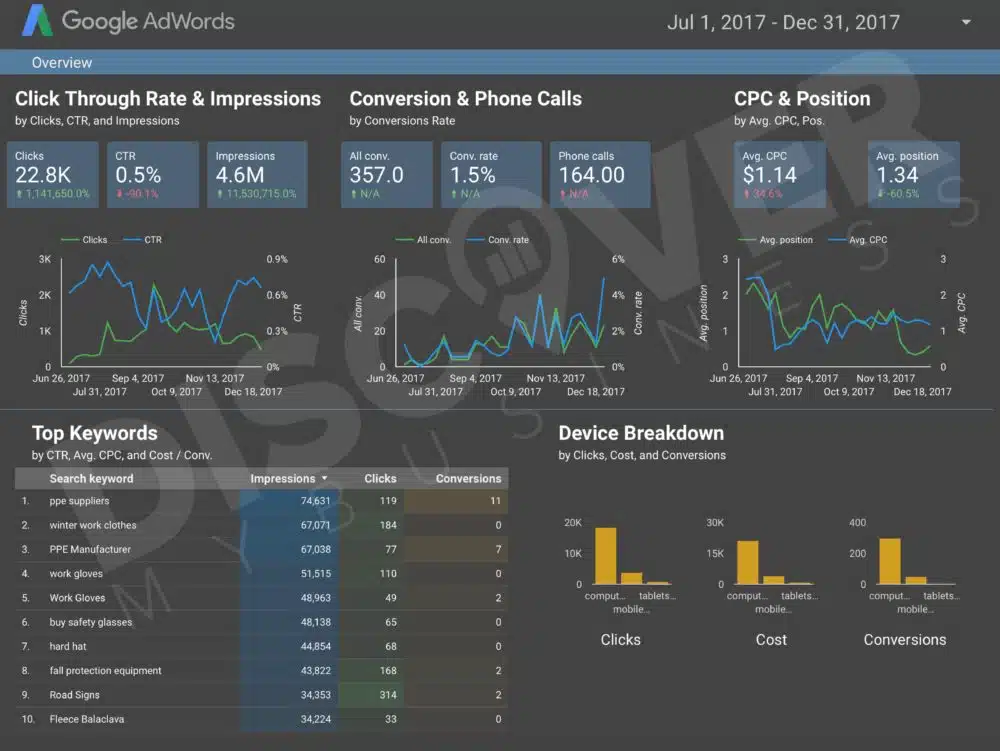
We overhauled their product feed infrastructure, rebuilt their Google Ads strategy, and segmented B2B from B2C traffic. Over six months, this unlocked 4.6M impressions, generated $250K+ in attributed revenue, and delivered a 900% ROAS.
Most Shopping campaigns fail before the auction.
When Shopping underperforms, the instinct is to look at bids, budgets and audiences. But a product that fails feed validation never enters the auction at all. No bid strategy reaches it. No budget increase finds it. It simply isn't there, and the account reports it as normal.
Tuning an account that can't serve.
Bids get adjusted, budgets get raised, audiences get refined. The products causing the problem are disapproved, so none of it reaches them. Spend concentrates on the handful of SKUs that happened to pass validation, and the catalog's real range never gets tested.
- SKUs eligible A fraction
- Catalog coverage Partial
- Impressions available Capped
- Ceiling Structural
Make the catalog eligible, then compete.
Identifiers completed, shipping configuration corrected, compliance errors resolved across every SKU. Only once the full catalog could serve did campaign structure and bidding start to matter, and then they mattered enormously.
- SKUs eligible 2,000+
- Impressions earned 4.6M
- Average CPC $1.14
- Return on ad spend 900%
Twenty-five years offline. No shelf space online.
PowerPak Civil & Safety wholesales construction safety and PPE equipment from Congers, New York, serving contractors and direct buyers across the US. The offline business was established and trusted. The digital one was invisible.
Not invisible in the sense of ranking poorly. Invisible in the sense that a large share of the catalog was not permitted to appear in Google Shopping at all.
Four problems sat underneath that.
-
The feed wouldn't validate
Merchant Center errors were causing product disapprovals across a 2,000-SKU catalog. Disapproved products don't bid, don't serve, and don't appear in performance reports as a problem. They simply produce nothing.
-
The catalog had no structure Google could read
Two thousand SKUs with no product-type taxonomy and no segmentation. Even approved, they'd have competed against each other for the same budget with no way to bid differently on a $12 pair of gloves and a $400 fall-arrest harness.
-
Search, Shopping and Display shared one undifferentiated account
No separation between B2B contractors buying in bulk and consumers buying single items, two buyers with different order values, different search language and different repeat behaviour, funded from the same pot.
-
Conversion tracking couldn't measure the outcome
Without reliable tracking there was no basis for optimisation. Every decision would have been a guess dressed as data.
Four steps, and the first one took the longest.
The order matters. Nothing downstream of the feed can be evaluated until the feed is clean.
Rebuild the product feed
Restructured and cleaned the full 2,000+ SKU feed. Resolved compliance errors, corrected shipping zone configuration, and worked the catalog until every product was approved and eligible to serve.
Unglamorous, slow, and the reason everything after it worked.
Build a structure the catalog could scale into
Search, Shopping, Display and Brand campaigns organised separately, with explicit segmentation between B2B and B2C buyers, and seasonal and regional demand patterns built into the architecture rather than bolted on later.
Two thousand SKUs stopped competing against each other for one budget.
Find the intent nobody was bidding on
Keyword and competitor research across the industrial PPE space, expanding into high-intent long-tail terms where a contractor searching a specific product specification is much closer to purchase than one searching a category.
Qualified traffic at $1.14 a click in a category most people assume is expensive.
Optimise against real conversion data
Tracking rebuilt so performance could be measured properly, then continuous refinement of bids, placements and audience segments, with dynamic remarketing bringing back buyers who had viewed products without ordering.
900% return on ad spend across the six-month period.
Four campaigns, four jobs.
Each budgeted and measured separately, so a campaign that worked could be scaled without one that didn't quietly absorbing the spend.
Search
High-intent B2B and industrial queries, contractors searching a specific product or specification, not browsing a category.
Shopping
Product-level visibility across the full approved catalog. The main driver of purchase-ready traffic once the feed was clean.
Display & remarketing
Reach beyond search volume, plus dynamic remarketing to bring back buyers who viewed products without ordering.
Brand
Defending searches for PowerPak's own name. Twenty-five years of reputation generates branded demand that competitors will happily intercept.
Feed management
Ongoing monitoring so approvals hold. Feeds decay: prices change, stock moves, requirements shift.
Conversion tracking
Rebuilt so revenue could be attributed to campaign and product, making optimisation a decision rather than a guess.
The arithmetic, in full.
Over six months the account generated 23,000 clicks from 4.6 million impressions at an average cost of $1.14. Those clicks converted at 1.5%, producing 357 orders and more than $250,000 in attributed revenue, a return of roughly nine times the spend.
The click-through rate looks modest at half a percent, which is what a Shopping and Display-weighted account produces. That's the correct trade in a category like this: broad product-level exposure across a large catalog, converted by a small number of high-value orders averaging around $700 each.
The number worth sitting with is the impressions. 4.6 million, from a catalog that, six months earlier, was largely not permitted to appear.
- Impressions 4,600,000+
- Clicks 23,000+
- Average CPC $1.14
- Conversion rate 1.5%
- Orders 357
- Attributed revenue $250,000+
If your Shopping campaigns underperform, check this first.
Open Diagnostics before Campaigns
Merchant Center Diagnostics tells you how many products are actually eligible. If that number is well below your catalog size, no bidding change will help.
Disapprovals are silent
A disapproved product doesn't error in your ad account. It produces nothing, and the report looks like ordinary underperformance.
Large catalogs need taxonomy
Two thousand SKUs in one undifferentiated campaign means you cannot bid differently on a $12 item and a $400 one. Product types and custom labels are what give you that control.
What went into it.
Six of our services, on one account.
How many of your products can actually appear?
Most merchants have never compared their eligible product count against their catalog size. Give us read access to Merchant Center and Google Ads and we'll tell you what's disapproved, why, and what it's costing you. Findings are yours to keep either way.
Read-only access · No obligation · You keep your accounts